Why Does Plex Hair Bleach Protect While Standard Bleach Doesn't?
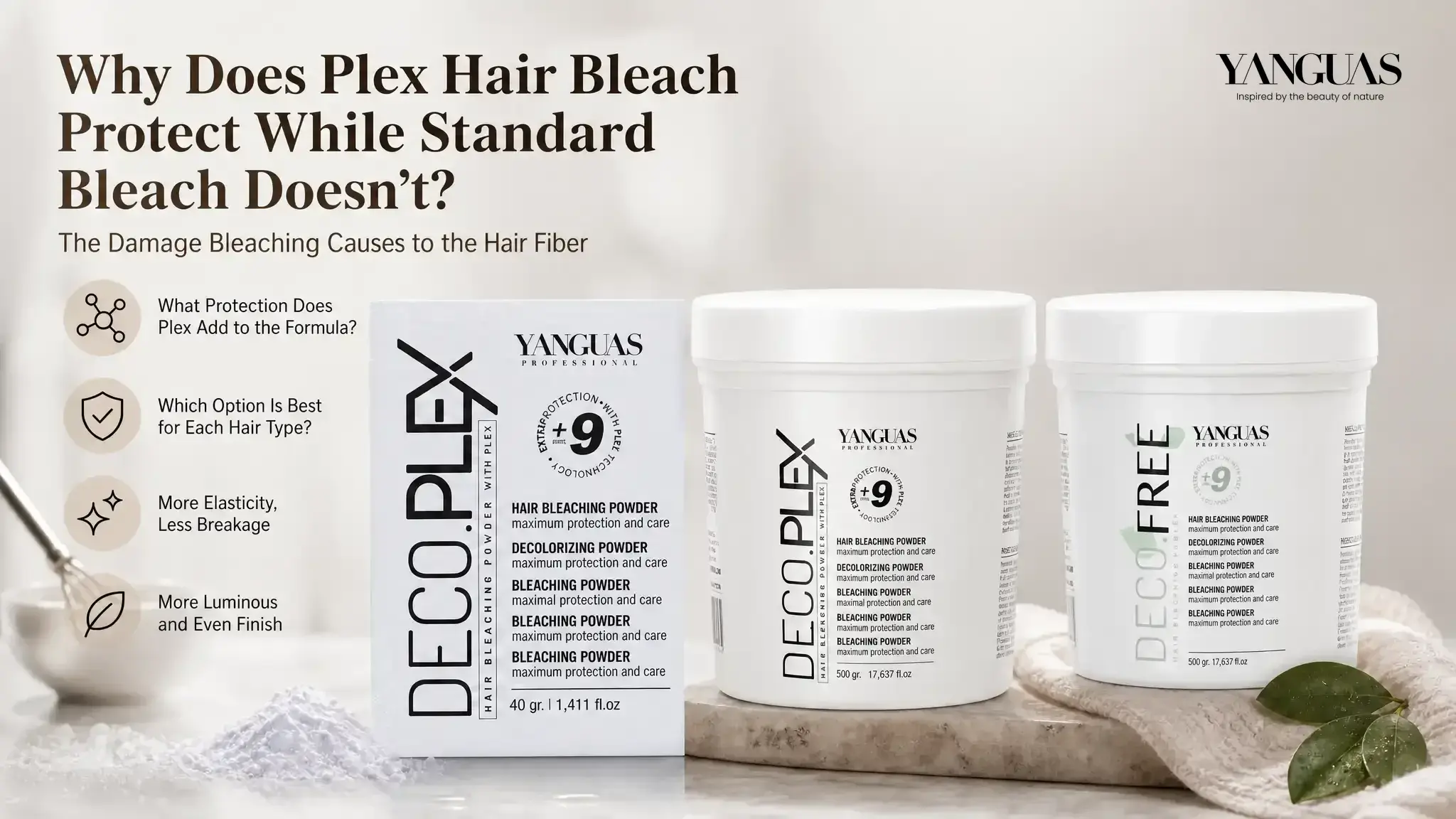
The fundamental difference is the presence of bond-protecting active ingredients in the formula: a bleach with plex incorporates ingredients that intersperse within the fiber during the chemical process to limit the breakage of keratin bonds, while a standard bleach only lightens. The visible result is hair with more elasticity, less breakage, and a more luminous finish after lightening.
The Damage Bleaching Causes to the Hair Fiber
The oxidizing agent that lightens the pigment doesn't just act on the color: it also affects the disulfide bonds of the keratin, which are responsible for the hair's mechanical strength. According to a study published in ScienceDirect, the bleach oxidant breaks these bonds, forming cysteic acid, which reduces the structural rigidity of the fiber's protein network.
This loss of bonds accumulates with each lightening session. Weakened hair breaks more easily, loses elasticity, and responds poorly to subsequent processes. The higher the desired lightening power, the greater the risk if there is no active protection in the mixture.
What Protection Does Plex Add to the Formula?
Bleaches with plex incorporate active ingredients into the formula itself that act during the oxidizing phase, not after. Yanguas Professional Deco.Plex technology contains PSC (Polyamino Sugar Condensate), a complex of sugars condensed with amino acids that conditions and hydrates the fiber while it lightens.
According to the technical publication Cosmetics & Toiletries, organic acids and low-molecular-weight active ingredients capable of penetrating the hair cortex reduce water absorption and the degree of damage to dyed or bleached fiber. PSC works on this same principle: it penetrates during the process and reinforces the internal structure.
The practical result is that the formula lightens up to 9 levels or more (compared to the 8 levels and more of the standard ammonia formula), with a mousse finish that facilitates uniform application, and with anti-red and anti-yellow power in both cases.
💡 Technical tip: if residual golden highlights remain after the process in a plex bleach, they can be toned directly with a 901 or 911 shade, without the need to apply another base product first.
Which Option Is Best for Each Hair Type?
The choice between the three available lightening formulas depends on the condition and history of the hair, not just the target shade.
| Formula | Protective active ingredient | Lightening power | Recommended hair profile |
|---|---|---|---|
| Powder Bleach with Plex (Deco.Plex) | PSC (sugars condensed with amino acids) | Up to 9 levels or more | Sensitized, dyed hair or hair with a history of chemical processes |
| Ammonia-Free Bleach with Plex (Deco.Free) | PSC + organic argan oil | Up to 9 levels | Ammonia-sensitive, dyed, or delicate hair; also suitable for highlights |
| Powder Bleach with Ammonia (Deco.Pro) | Protective action without plex complex | 8 levels and more (also stripping) | Resistant or natural hair without previous processes |
When hair has undergone several processes or the lightening aims for a very light blonde, the plex version reduces the risk of split ends and better maintains the integrity of the cuticular layer. The standard formula remains suitable for resistant virgin hair where the lightening goal is moderate.
The ammonia-free version with plex also adds organic argan oil, making it particularly suitable for reactive scalps or for highlighting services where skin contact should be minimized.
To see the full range of lightening systems with Deco.Plex technology and choose the format that fits your service, all the information is at Yanguas Professional Deco.Plex.