
When to Use 20 Volume Developer and How Much to Add to the Dye
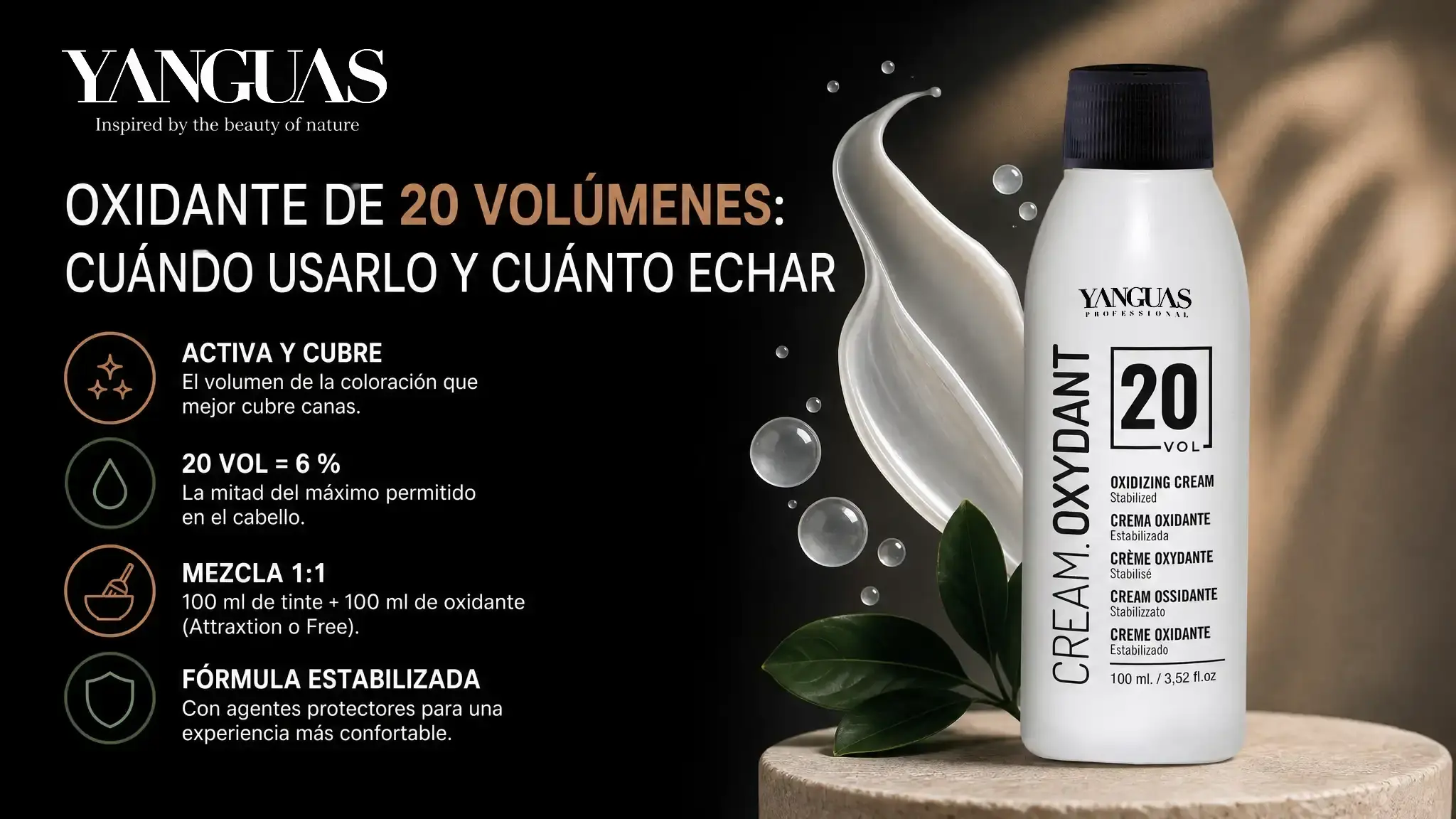
A 20 volume developer is the hydrogen peroxide cream that activates a permanent dye: the number measures its strength, and 20 volumes is half the maximum the law allows on hair. It is the volume of the colour that covers grey, and with Attraxtion or Free it is mixed in equal parts, 1:1.
What Does the Volume Number on a Developer Measure?
Volume is the traditional way of stating the peroxide concentration of a developer: how many volumes of oxygen one volume of product can release. More volumes means more peroxide, more lifting power and more chemical work on the fibre.
The link to a percentage comes from the EU cosmetics regulation itself, which caps hair products at 12% and writes that cap as 40 volumes. The scale is proportional, so a 20 volume cream works at 6%.
That 6% is exactly the concentration a review in the International Journal of Trichology gives for permanent dyes, against 2% for demi-permanent ones. The same review explains that permanent colour is the one that covers grey best, because the pigment reaches the cortex through an oxidation reaction.
Developer, oxidant, peroxide and activator all name the same part of the mix. The Attraxtion chart says «oxigenada» for some series and «peróxido» for others, and Yanguas sells its 5 volume as a developer or catalyst. Salons work with a cream: the Yanguas one is a stabilised cream developer, made to be mixed with its dyes, with protective agents so that sensitive skin does not itch during processing.
When to Use 20 Volumes, and When 10, 30 or 40
The volume is chosen by what the service has to do with the base: deposit colour and cover, lift while colouring, or simply tone without lifting. The Yanguas charts give each volume a specific job:
| Volume | What the chart uses it for |
|---|---|
| 5 | Toning highlights with Free 900 and 901, no lift on the base |
| 10 | T00 acid toners, which neutralise without lifting |
| 20 | Natural extra 8X and 9X, Contrast, Deco.Plex |
| 30 | Super lighteners 900 to 903, Contrast, Deco.Plex |
| 40 | The same as 30, at the legal ceiling |
Read top to bottom, the table says that 20 is the colour volume, and that 30 and 40 come in when the dye also has to lift. The super lighteners, for example, lift 3 to 4 tones, always on a natural base no darker than a light brown.
In bleaching, the choice depends on how much lift you are after. The powder bleach with ammonia and the ammonia-free one with Plex both take developer at 5, 10, 20, 30 or 40 volumes, and Deco.Plex works with 20, 30 or 40. None of their sheets assigns a number of tones to each volume; the Deco.Plex one notes that its lift, up to 9 tones or more, depends on the starting base.
What Ratio Do You Mix Dye and Developer In?
The general rule for Yanguas permanent colour is the equal-parts mix, 1:1: a 100 ml tube of Attraxtion with 100 ml of developer. Free follows the same ratio with the brand's stabilised cream developer and a processing time of 30 to 45 minutes, depending on the base shade and the tone you want.
The exceptions are written in the chart, and nearly all of them raise the developer share:
- Attraxtion and Free
- 1:1, 100 ml dye to 100 ml developer
- Natural extra 8X and 9X
- 1:1.5 with 20 vol, 45 min
- Super lighteners 900 to 903
- 1:1.5 with 30 or 40 vol, 30 to 45 min
- Contrast
- 1:1.5 with 20, 30 or 40 vol
- T00 acid toners
- 1:1 with 10 vol, 10 to 25 min
A 1:1.5 mix carries more developer per millilitre of pigment, and the chart gives it its own time. If you stop at 100 ml of developer instead of 150 on an 8X, you have made a 1:1 with a time meant for another mix, and the result is no longer the one on the chart.
With Free, above 70% grey the sheet changes the dye: half a tube of the shade and half of the fundamental at the same level. Hidracolor, the direct colour, is mixed with nothing, because it works without oxidation. Keep the chart for each professional colour line at the station, because the ratio changes from one series to the next.
💡 Technical tip: measure the developer with a measuring cylinder or on the scale, never by eye from the 1000 ml bottle; a 50 ml error shows most in the 1:1.5 series.
The pairing matters too if the colour is to come out the same every time. Yanguas recommends its cream developer for Attraxtion and Free and describes it as formulated to always give the optimal lifting power and the same colour uniformity; in its technical series, the chart names its own developer.
What the EU Regulation Sets for Hydrogen Peroxide
Hydrogen peroxide is listed in Annex III of Regulation (EC) No 1223/2009, the list of substances a cosmetic may contain only within limits. For hair products the limit sits in entry 12: 12% H2O2, which the text itself writes as 40 volumes, present or released. No hair product may exceed it.
The same entry requires four label warnings: wear suitable gloves, state that the product contains hydrogen peroxide, avoid all contact with the eyes, and rinse the eyes immediately if the product gets into them. At the station, gloves go on when the developer is opened and stay on until the colour is rinsed.
For scalps that itch, Yanguas has two aids apart from the developer itself. Color.Protect is added a few drops at a time to the dye mix, gives the colour extra shine and prevents possible itching in people with hypersensitivity; Stain.Remover lifts the dye stains left on the skin during the service.
If your next service is a natural extra blonde, measure 100 ml of 8X or 9X with 150 ml of 20 volume cream developer, leave it for 45 minutes, and ask your zone distributor for the 1000 ml size once colour is a daily service at your salon.