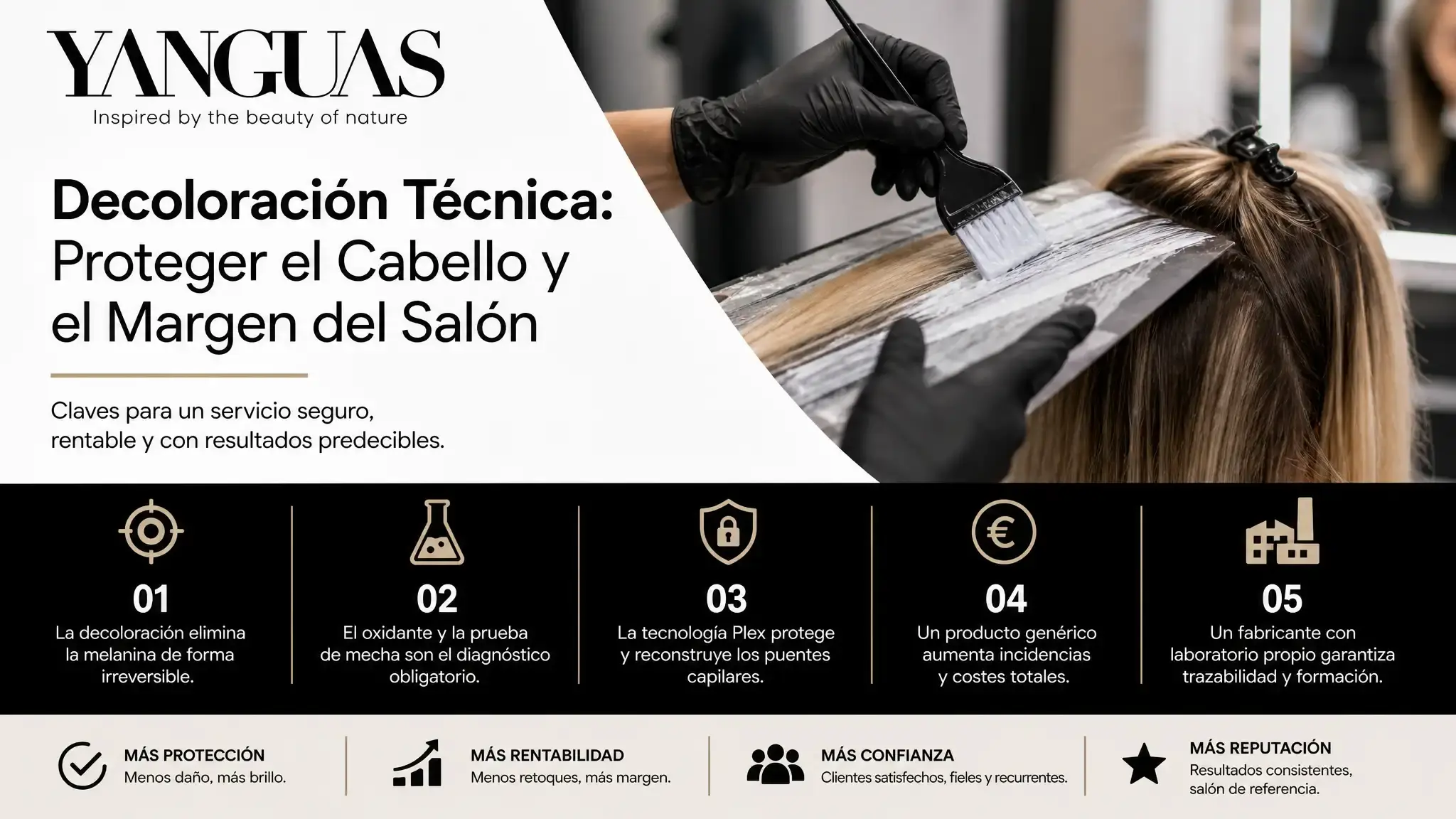
Technical Bleaching: Protecting the Hair and the Salon's Margin
Balayage, highlights, and extreme bleaching generate more demand today than any other technical service, and also more problems when something goes wrong. An orange tone, hair that breaks when combed, or a client who doesn't return after a poorly managed service are costly, and not just in reputation: they cost real income.
Bleaching is the most aggressive process that can be applied to the hair fiber, and many salons approach it with the same criteria they use to choose a mask—price, presentation, and availability. In services of this level, that approach has direct consequences on the result and on the profitability of the business. This article reviews what professional bleaching really requires, from the oxidant to pre- and post-treatment protocols, and how the product's origin affects the client's hair and the bottom line.
Key Takeaways
The keys to safe and profitable professional bleaching:
Why Bleaching Is the Most Demanding Service
Unlike permanent coloring, which deposits pigment while oxidizing, bleaching pursues a single goal: to remove natural melanin in a controlled manner. The process is irreversible because once the melanin is degraded, it cannot be recovered.
The complexity skyrockets when the hair has already been treated. Previous coloring, keratin, straightening, or repeated highlights modify the porosity and resistance of the fiber, so each case is different and the professional's experience carries as much weight as the product.
Added to this is the fact that bleaching, due to its duration and technical demand, is the highest-cost service for the client. Any failure in the result directly impacts trust and the likelihood of the client repeating the service.
What Happens Inside the Fiber During the Process
The hair fiber is made of keratin and protected by a layer of scales, the cuticle. When applying the bleach, the persulfates that activate the process lift that cuticle to penetrate the cortex and oxidize the melanin pigments.
This process deteriorates the disulfide bonds, the molecular links that provide strength and elasticity to the hair. As Kérastase explains in its technical documentation, bleaching damages the cuticles, makes the fiber hyper-porous, causes it to lose moisture easily, and leaves it vulnerable to external aggressions, from the heat of the dryer to the chlorine in the pool.
The damage is not always visible at the time. It often appears weeks later, when the hair begins to break, become dull, or lose elasticity, and by then the cause is already difficult to pinpoint. In hair with repeated balayage, some industry specialists recommend amino acid reconstruction or hair botox protocols, because standard home maintenance is not enough.
Choosing the Oxidant: The Most Underestimated Decision
The oxidant is the cofactor that determines the speed and intensity of the reaction, and it remains the part of the process most often improvised in the salon. The concentration of hydrogen peroxide defines how much the cuticle is lifted and how quickly the persulfate acts.
A 40-volume oxidant applied to already processed hair is not a faster option: it is a real risk factor for breakage and irreversible damage. According to the Aula de Peluquería, before selecting the volume, it is essential to evaluate the type and condition of the hair through a strand test; on dry or damaged hair, a high concentration aggravates the problem instead of solving it.
The strand test is not optional: it is the preliminary diagnosis that protects the client and the professional. The mixing ratio also counts, and a well-formulated technical bleach indicates precise ranges—for example, from 1:1.5 to 1:2.5 depending on the hair condition—instead of a one-size-fits-all ratio.
💡 Before mixing: always perform a strand test on an inconspicuous section and adjust the oxidant volume to the result, never to the haste of the service.
What Differentiates a Technical Bleach from a Generic One
Under the same "professional bleaching powder" label, very different products coexist. The difference is in the formulation, not the packaging. A well-developed technical bleach incorporates, in addition to the lightening agent, amino acids, fiber conditioners, pH agents, and protective actives that act simultaneously to reduce stress on the cuticle and cortex.
A generic bleach cheapens its formula by eliminating precisely those components. The result at the chair may seem similar, but the state of the hair after washing, and its evolution in the following days, reveals the difference.
For the salon, a technically inferior product means more service time spent on touch-ups and tone corrections, a higher probability of incidents, and a higher post-treatment cost. The lower purchase price rarely compensates for the total cost of the process.
Plex technology has transformed intense bleaching services. According to L'Oréal París, Plex treatments artificially rebuild the broken protein bonds at a molecular level, compared to other superficial treatments that only act on the cuticle. The most complete systems work in two or three steps: the first is incorporated into the bleaching mixture to protect during application, the second stabilizes the bonds after rinsing, and the third prolongs the effect at home. When Plex is integrated into the bleach formula itself—as in the bleaching powder with Plex—and not just as a separate additive, the protection is more uniform throughout the entire process.
Pre- and Post-Treatment Protocols
Bleaching starts before opening the powder container. A correct hair diagnosis and adequate pre-treatment make the difference between a brilliant result and a service with issues. These are the four steps that structure a reliable pre-treatment:
| Step | Objective |
|---|---|
| Porosity and resistance diagnosis | Strand test to choose the correct oxidant volume |
| Evaluation of treatment history | Adjust formula, volume, and time according to color, keratin, or previous bleaching |
| Prior hydration for porous hair | Hydrating treatment the week before to reduce damage |
| Use of Plex from step 1 | Protect hair bonds throughout the application |
The post-treatment is not the end of the service: it is the first impression the client takes home, and the hair that leaves the salon defines whether there will be a second visit. After rinsing, step 2 of the Plex system stabilizes the rebuilt bonds and closes the cuticle, visibly improving shine and manageability.
In balayage or intense bleaching, it is advisable to complete the service with amino acid reconstruction or hair botox, instead of a standard mask, thus justifying a higher value-added service. The salon that prescribes personalized home maintenance not only cares for the client: it builds the relationship of trust that turns one-off visits into loyal clientele.
Every Technique Demands a Formula, and the Manufacturer Matters
Balayage, highlights, and global bleaching do not share the same formula, and believing otherwise is one of the most frequent mistakes in salons with a limited catalog. Balayage, applied freehand and without aluminum foil, generates heat through direct contact, accelerates the reaction, and requires a bleach with good consistency to avoid dripping.
According to Master Hair Academy, techniques like foilayage—freehand application combined with aluminum foil—produce faster and more intense lightening, so it is essential to check the fiber periodically to avoid overexposure, especially on dark or resistant hair. Foil highlights require a firmer texture, and global bleaching demands a formula that holds up for long periods without losing effectiveness or adding damage.
The bleach manufacturer also conditions the professional's reputation. Working with a manufacturer with its own laboratory guarantees traceability of each batch, agile formulation adjustment, and access to real technical information, not just sales pitches. The consistency of results—on which the reputation of a salon specializing in advanced colorimetry is built—depends largely on the consistency of the product. Added to this is training: according to industry experts, correcting a previous dark color through gradual bleaching, with low volumes and separate sessions, reduces the risk of cumulative damage. Salons that combine technical products and continuous training achieve predictable results, loyal clients, and services with real margins.
Frequently Asked Questions
Can a poorly done bleaching be reversed?
No. Bleaching degrades melanin irreversibly and, if it also breaks the disulfide bonds without protection, the structural damage is permanent. Only the tone and, partially, the condition can be corrected through reconstruction, but the removed melanin cannot be recovered.
What oxidant volume should I use on already processed hair?
Never the highest by default. A 40-volume oxidant on previously treated hair skyrockets the risk of breakage. The rule is to do a strand test, evaluate porosity and resistance, and choose the lowest volume that achieves the desired lightening.
What is Plex technology used for in bleaching?
Plex rebuilds the disulfide bonds that the bleaching process breaks at a molecular level. It acts from within the fiber during and after rinsing, and protects better when integrated into the bleach formula, not just added as a separate additive.
Does the same bleach formula work for balayage, highlights, and global bleaching?
No. Balayage generates heat through contact and requires good consistency; foil highlights ask for a firm texture; and global bleaching needs a stable formula for long periods. A technical catalog that differentiates these uses is an operational necessity, not a luxury.
Is it worth buying a cheaper bleach?
Rarely. A generic bleach usually cheapens the formula by eliminating amino acids, conditioners, and protective actives, which increases touch-ups, incidents, and post-treatment costs. The total cost of the service ends up being higher than the initial savings on the purchase.