
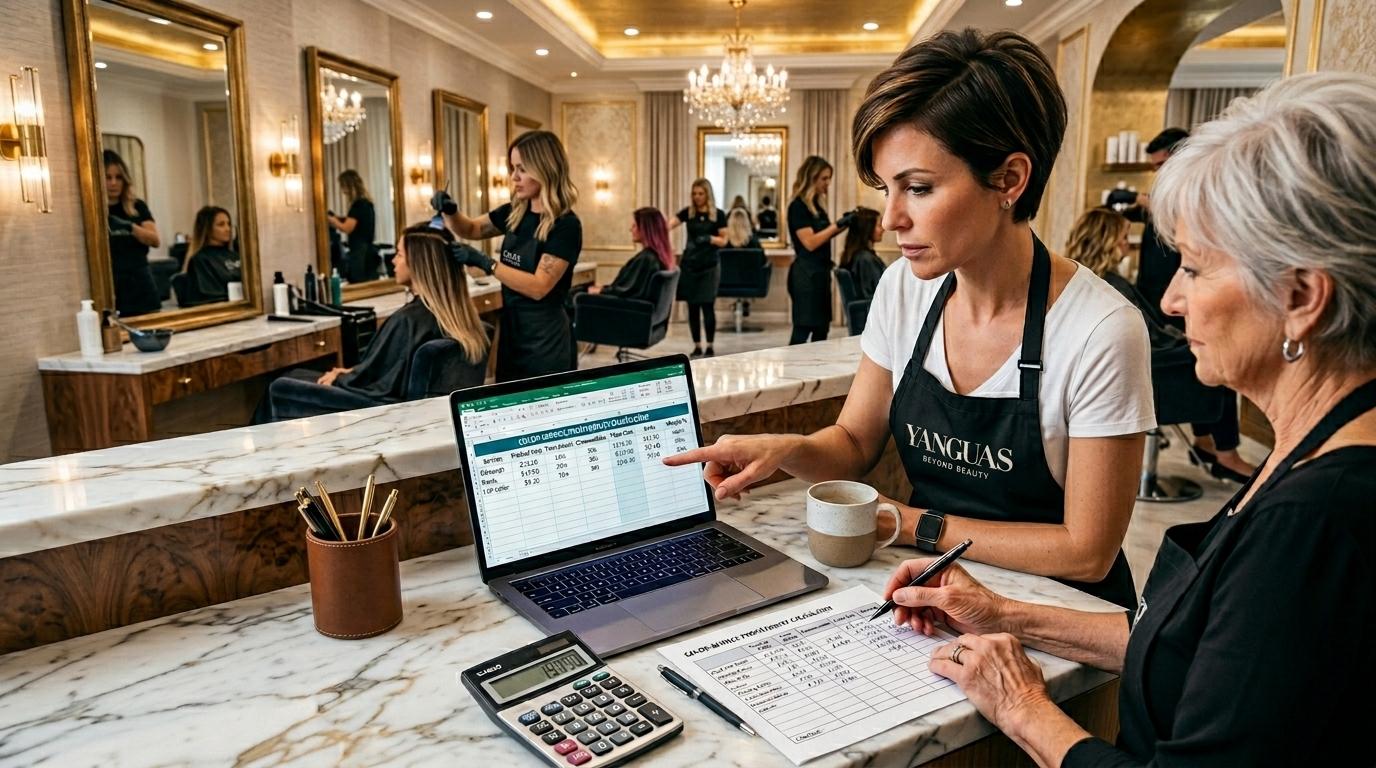
The real margin of a coloring service is calculated by subtracting three cost blocks from the selling price: the product consumed, the stylist's time, and the proportional part of the salon's fixed expenses. A service is profitable when that difference leaves, at a minimum, between 10% and 20% of the price as net profit.
Why the Selling Price Says Nothing About Profitability
A service can have a high price and still leave little margin, and a moderately priced one can be very profitable if costs are controlled. The only way to know is to understand the second number in the equation: how much it actually costs to produce that service.
According to the analysis by OrdanAI, no need, the average gross margin in beauty salons is between 55% and 70% depending on the service mix, and a margin below that range indicates a problem in input costs or the set price, not in customer volume.
Which Three Cost Blocks Need to Be Added
Every coloring service distributes its cost into three items that are rarely calculated separately:
Product cost (direct variable). Dye, oxidant, professional shampoo applied in the booth, post-color mask, gloves, and aluminum foil or cap in the case of highlights. Nothing consumed in the service is free, even if its unit cost seems insignificant.
Time cost (labor). The stylist's time has an hourly cost calculated by dividing the total monthly salary cost (including Social Security paid by the company) by the productive hours of the month. That hourly cost is allocated to each service according to its actual duration.
Structure cost (allocated fixed costs). Rent, utilities, insurance, management software, and cleaning materials exist regardless of the volume of services, but they must be distributed among them to know how much each weighs in the total.
How to Calculate the Product Cost per Application
The starting point is measuring how much product is actually used in the booth, not what the packaging indicates. For two weeks, recording actual consumption by service type (full coloring, root touch-up, highlights, color bath) allows for calculating a reliable unit cost based on the purchase price per kilo or per unit.
- Dye
- 60 g at 0,08 €/g = 4,80 €
- Oxidant
- 90 ml at 0,03 €/ml = 2,70 €
- Post-color shampoo and mask
- 1,50 €
- Gloves, foil, and consumables
- 0,60 €
- Total product cost
- approx. 9,60 €
This example corresponds to a full coloring and varies according to the range used. The supplier directly influences this figure: a manufacturer that sells without intermediaries reduces the product cost without affecting the technical quality of the formula, because the price does not incorporate the margins of each link in a distribution chain.
How Labor Cost is Calculated
A full coloring service with washing and finishing takes between 90 and 120 minutes. The formula to find its cost is:
Hourly cost = (monthly gross salary + Social Security paid by the company) / monthly productive hours.
If a stylist's total salary cost is 2.000 € per month and they work 150 productive hours, their hourly cost is 13,33 €. A 90-minute service then represents about 20 € in labor, a figure that many salons never allocate to the final price of the service.
💡 Practical tip: record the actual time of each type of coloring (not the theoretical one) for a month before setting the labor cost per service; the actual duration is usually longer than what is used for budgeting.
What Weight Should Costs Have on the Final Price
Once product, labor, and structure are added, the total cost of the service is obtained. The selling price must leave, over that cost, the margin that makes the business sustainable.
| Item | Approximate weight on the selling price |
|---|---|
| Product cost | 15-20% |
| Labor cost | 40-50% |
| Structure cost | 15-20% |
| Target net margin | remaining 10-20% |
These ranges coincide with what Gestron describes, no need: the contribution margin of a service is calculated by subtracting the variable cost from the selling price, and the required net profit determines how much the salon must bill each month to cover structure and profit goals. If the product cost exceeds 20% of the price, the service may be poorly priced or the supplier is absorbing too much margin through unnecessary intermediaries.
How to Know if a Coloring Service Really Makes Money?
The two formulas that resolve the doubt are:
Gross margin = selling price − direct product cost. Net margin = selling price − (product + labor + structure).
If the net margin is negative or falls below 10%, the service does not generate real profitability, and the effect is greater in coloring because it is usually one of the salon's highest-volume services. Reviewing these calculations once a quarter is enough to detect deviations before they accumulate in the income statement.
What Role the Supplier Plays in This Calculation
The choice of supplier is not just a matter of product quality: it is a decision that directly affects the product cost of each service. When a brand passes through several distributors before reaching the salon, each link adds its margin, and that extra cost is passed on to the gram of dye the salon buys.
If the product cost rises from 15% to 25% of the service price for this reason, the net margin can be cut in half without the price to the customer having changed. Working with a direct manufacturer, who controls their own production and distributes without intermediate layers, is one of the factors that weighs most when it comes to sustaining the margin of a technical service like coloring.