Sustainable Cosmetics Attract Customers That Price Cannot Keep
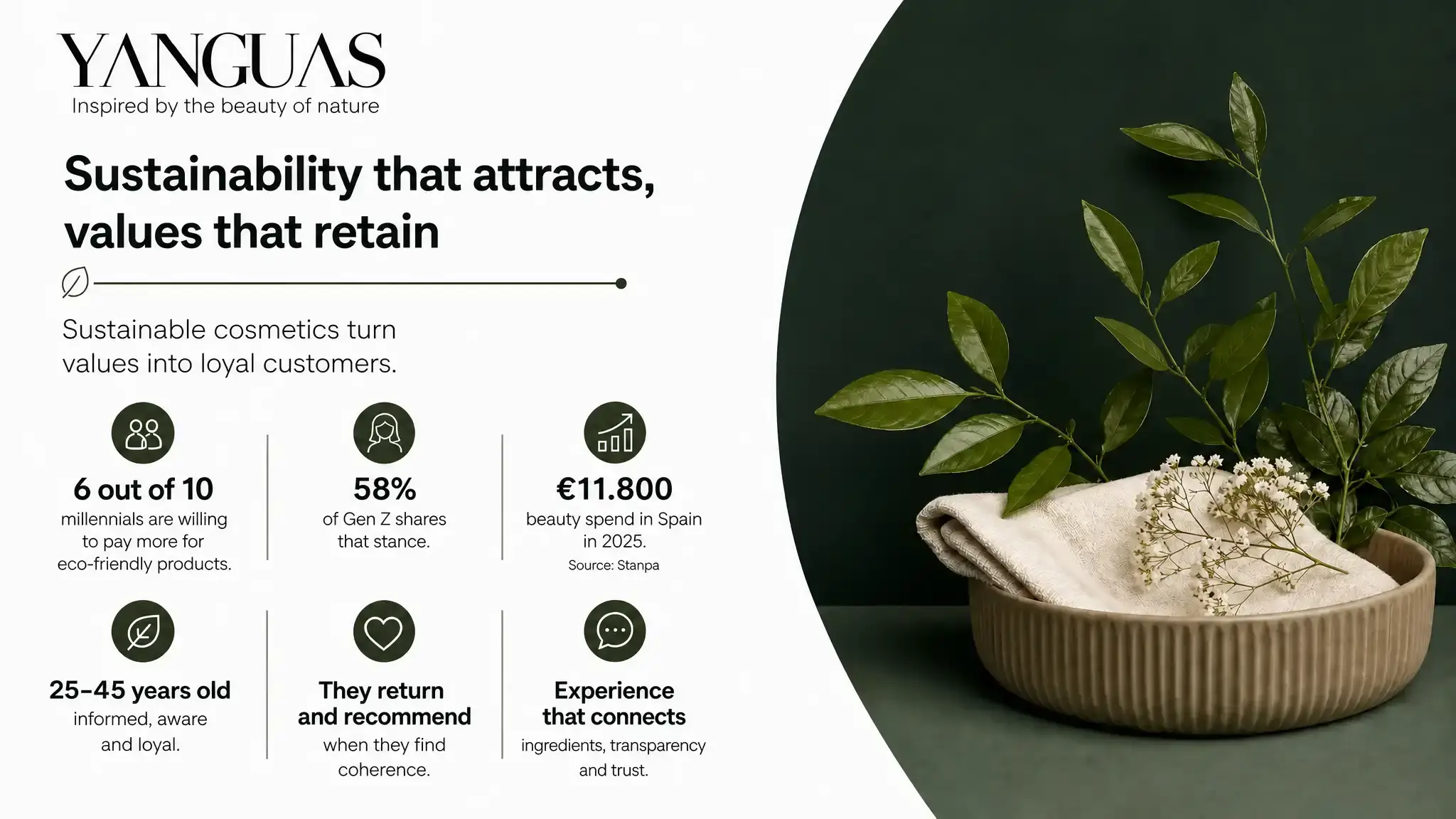
Sustainable cosmetics attract customers who do not choose based on price or proximity; they choose the salon that shares their values. According to a study by GlobalWebIndex collected by Reason Why, 6 out of 10 millennials are willing to pay more for organic products, and 58% of Generation Z share that willingness. Incorporating sustainable cosmetics turns this data into new and recurring clients.
The Profile of Customers Seeking Eco-Responsible Salons
This is not a marginal niche. It is a segment growing alongside the beauty market in Spain, which in 2025 exceeded 11.800 million euros in consumption, according to Stanpa, the National Association of Perfumery and Cosmetics.
These customers are between 25 and 45 years old, check the composition of what they buy, follow conscious beauty accounts, and connect their personal care routine with their environmental decisions. They are not just looking for a cut or color: they seek an experience consistent with their lifestyle. When they find a salon that offers it, they return and recommend it.
The loyalty of this profile is its most valuable trait for the salon. Unlike the customer who visits for a specific offer, the eco-conscious customer builds a relationship based on trust in the brand and the products the professional uses.
What Signals Do These Customers Look for Before Entering the Salon?
Before booking an appointment, these customers perform a quick scan of the salon: its social media profile, the brands it advertises, and the language it uses. There are four specific signals that accelerate the decision.
Natural origin ingredients in the salon's products. It is not enough for the professional to know them: they must be mentioned in communication. Formulas with plant-based actives, without questioned ingredients, and with a high percentage of natural origin are the first sign of credibility.
Transparency regarding processes. Sustainable customers value the salon explaining what is used and why. Low-ammonia coloring, vegan formulas, or sulfate-free shampoos are arguments that, when well-explained, work better than any discount.
Packaging and visible rituals during the service. Product packaging, organic cotton towels, the gesture of reading the label with the customer: everything communicates. What is seen and smelled in the chair builds value perception as much as the technical result.
Finally, the consistency of the salon as a space. Eco-conscious customers quickly detect the contradiction between a "natural salon" sign and a counter full of mass-market products. Congruence between the message and the products in use turns the visit into a recommendation.
Sustainable Cosmetics Change the Service Experience
The impact of sustainable cosmetics is not just about image: it changes the interaction with the customer during the service. A shampoo with over 97% natural origin ingredients, a vegan mask, or a treatment formulated without questioned preservatives opens a conversation that conventional products do not.
That conversation is the real lever for acquisition. When the professional explains the origin of an active ingredient, the reason for a formulation, or the process behind a product, they give the customer something they do not get at the salon next door: context. And context generates trust.
💡 Professional tip: Spend the first two minutes of each visit naming one or two ingredients of the product you are going to use and their function. Not as a masterclass, but as part of the ritual. This gesture turns a standard service into a differential experience that the customer remembers and discusses.
Sustainability also naturally increases the average ticket. Customers who understand the value of responsible formulation better accept the real price of the service, without the need to justify margins or compete with discount offers.
How Sustainable Salons Differ from Traditional Ones
The difference is not just in the products: it is in the positioning those products project outward. A salon working with sustainable cosmetics has something concrete to communicate, giving it an advantage on two fronts.
The first is organic acquisition. Eco-conscious customers actively search for salons that work with responsible brands or formulas. When the salon appears in that search, conversion is higher because the customer arrives predisposed. There is no need to convince; you just confirm what they already expected to find.
The second is differential loyalty. As documented by Estética Magazine España in its analysis of environmentally committed hair salons, professionals like Àlex Agramunt from Alma Hair Spa Salon (Barcelona) describe how sustainable practices generate an emotional bond with the customer that goes beyond the service. When customers feel part of something larger than a haircut, the relationship with the salon changes: it stops being transactional and becomes identity-based.
That bond is almost impossible to replicate with a discount.
Sustainability Drives Customer Acquisition on Social Media
Sustainable cosmetics naturally generate content, and content generates reach. Showing ingredients, explaining a vegan formulation, or sharing the process behind a silicone-free treatment: each of these actions produces posts that committed customers share because they reinforce their own identity.
No production budget is needed. A short video showing a label reading, a photo of the packaging with its ingredients, or an explanation of the process behind low-impact coloring are pieces that work because they are honest and technical. They are the type of content that attracts a new customer before they have even stepped into the salon.
The word of mouth is also amplified. Customers who have a sustainable experience in the salon have a specific story to tell: the ingredients used, the conversation they had, how they were told why that product and not another. That story travels better than "the cut was very good".