Sustainability in Hairdressing: From Green Marketing to Real Practice
Back to the blog

Sustainability in Hairdressing: From Green Marketing to Real Practice

Talking about sustainability in hairdressing is no longer about the future: it is about the present. But between the "eco", "green", and "conscious" labels, the sector carries a serious problem: too much marketing and little substance still coexist in the same storefront.

This guide does not seek to convince anyone that change is urgent. It seeks to help the professional understand what it means to operate a sustainable salon, what it implies economically, and how to build an honest positioning that the client can verify.

Key Takeaways

Before going into detail, here is the essential information about real sustainability in the beauty salon:

What Does Being a Sustainable Hair Salon Really Mean?

Sustainability in a beauty salon is not reduced to placing a recycling sign at reception or offering "natural" dyes of unknown origin. It implies a structural commitment to the environmental, social, and economic impact of the business, measurable and verifiable in every process.

According to Green Salon Collective, a sustainable hair salon reduces its footprint by adopting practices that cover organic dyes, biodegradable products, efficient appliances, and water-saving measures, in addition to recycling materials such as aluminum, color tubes, and the cut hair itself. None of these axes work in isolation.

The concept of bio-hairdressing adds an additional layer: the philosophy of integral well-being, where the salon environment—ventilation, furniture materials, indoor air quality—is part of the commitment to the health of the client and the team.

The Profile of the Conscious Client

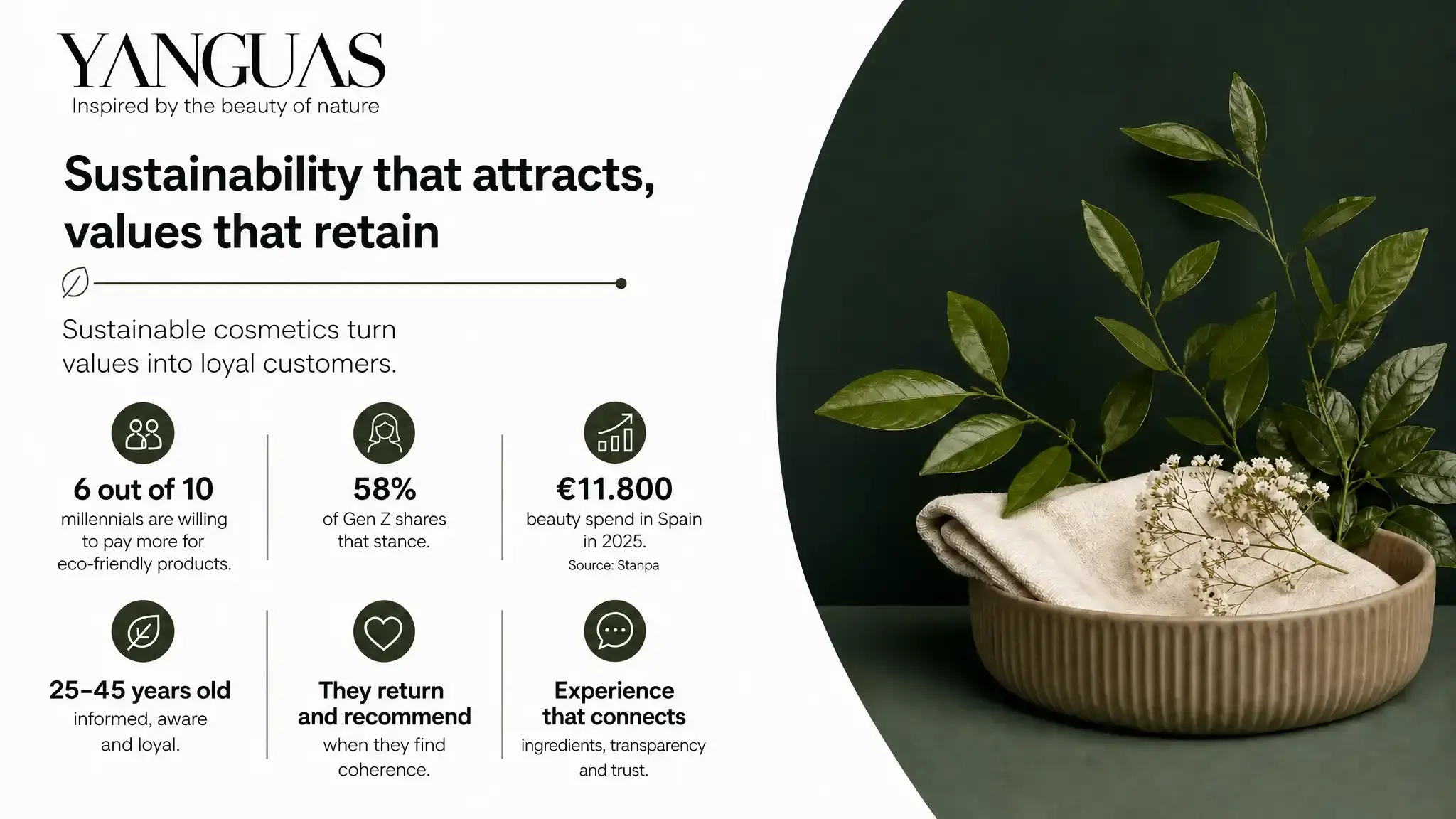
The client looking for a sustainable salon is not a marginal niche. According to a survey by the British Beauty Council reported by Edie, 41% of consumers feel guilt about the environmental impact of their beauty and personal care products and are willing to change their purchasing habits accordingly.

In Spain, this consumer responds to a specific profile: they are between 28 and 50 years old, with a greater female presence. They check ingredients before using them and value transparency regarding manufacturing processes.

They are willing to pay more if the value proposition is clear and credible. What they do not forgive is inconsistency: a salon that talks about sustainability but displays products in single-use plastic packaging, or that has no certification to back up its claims, loses credibility immediately.

The Environmental Impact of a Conventional Salon

Before talking about solutions, it is worth measuring the problem. A medium-sized conventional salon generates an impact that most owners are unaware of in detail.

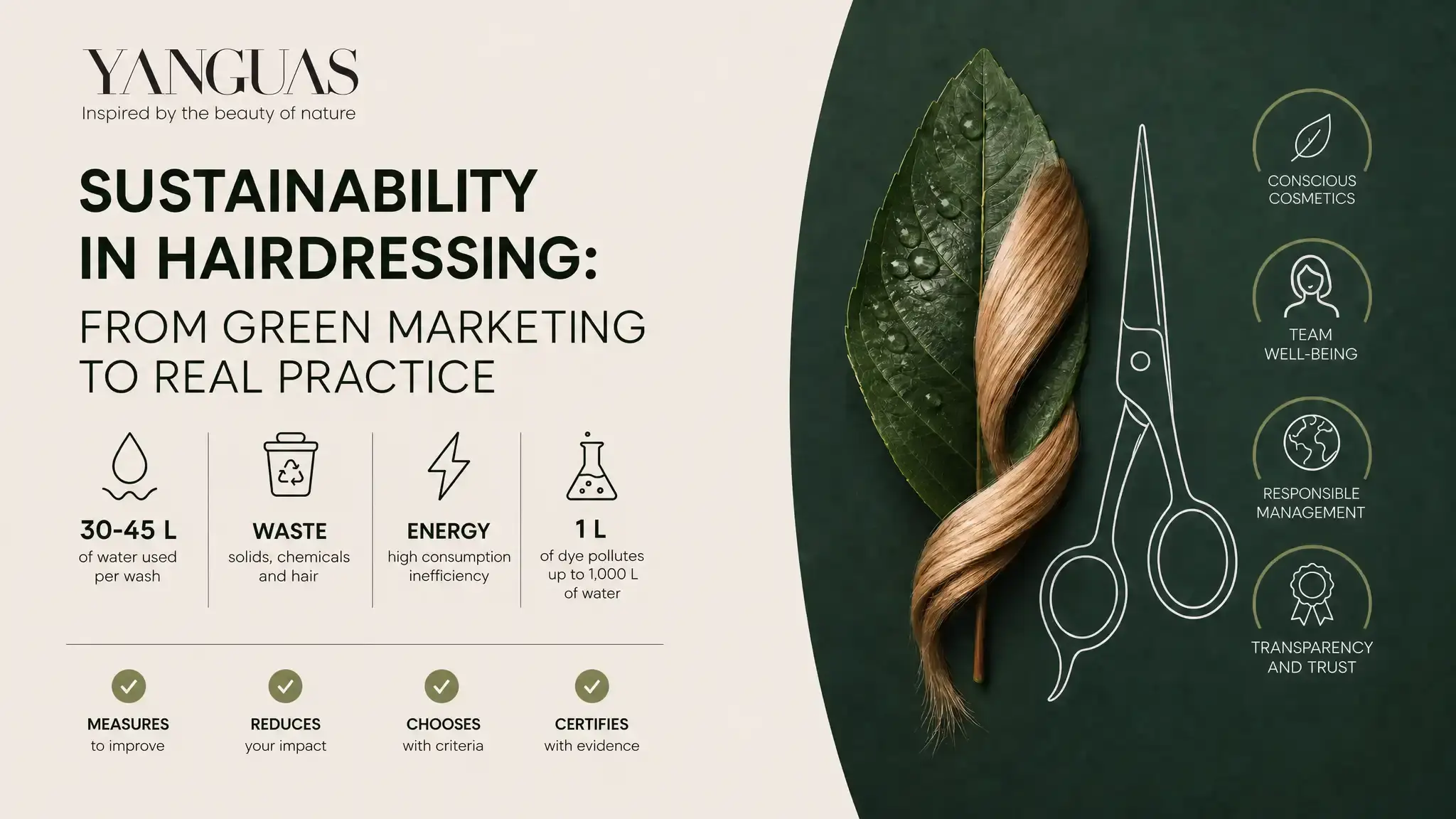
Area Estimated impact
Water 30–45 liters per wash, many contaminated with dye residues
Solid waste Gloves, capes, packaging, aluminum, and cut hair
Energy Hairdryers, flat irons, and air conditioning without efficiency measures
Chemistry 1 liter of poorly disposed dye can contaminate up to 1,000 liters of groundwater

Solid waste deserves a separate mention due to its volume. According to figures collected by Clic Recycle, Spanish hair salons generate more than 7,000 million kilos of hair per year, most of it destined for landfills instead of being reused.

Oxidative dyes, bleaches, and texture-changing products contain compounds that, if not managed correctly, contaminate the soil and riverbeds when discharged without prior treatment.

From Conventional Hairdressing to Bio-hairdressing

The transition does not have to be radical or immediate. The most frequent mistake is transforming the salon overnight, assuming unsustainable costs and losing regular clients due to a change in offering without communication.

A progressive approach is usually structured in four phases:

1. Internal audit. Before changing anything, measure how much water the salon consumes per week, how much waste it generates per month, and what percentage of energy comes from renewable sources. Without data, there is no plan.

2. Reduction of operational waste. Replacing disposable gloves with reusable ones, eliminating single-use plastic at reception, implementing waste separation, and contacting authorized managers for chemical waste. Low-cost measures with real impact.

3. Review of the product catalog. Prioritize manufacturers that offer verifiable documentation on their processes: declared composition, manufacturing certifications, and packaging policy. It is not enough for the supplier to claim to be sustainable.

4. Progressive certification. Programs like Green Salon Collective or the European Ecocert offer accessible certification frameworks for independent salons. A recognized certification is the strongest argument against a skeptical client.

💡 Professional tip: always start with the internal audit. Without a prior measurement of water, energy, and waste consumption, any subsequent change is difficult to communicate with real figures.

Transparency, Ethics, and Economic Benefit

The greenwashing—the cosmetic use of sustainability as a marketing tool without real backing—has eroded consumer trust to worrying levels. In a sector where the client has increasing access to technical information, inconsistency is paid for dearly.

An ethical salon operates under a simple principle: only communicate what you can prove. This implies transparency in the origin of products, in the working conditions of the team, in waste management, and in the energy footprint of the space. Working with manufacturers that accredit their production processes through certifications such as ISO 22716 Good Manufacturing Practices is a decision that the salon can communicate with pride and that the client can verify.

The perception of extra cost is one of the most frequent barriers to adopting these practices, but the data points in another direction. Installing low-consumption showerheads at the backwash units can reduce water expenditure by between 40% and 65% without affecting service, and photovoltaic energy models pay for themselves in increasingly shorter periods. Furthermore, salons with verifiable sustainable positioning tend to have a higher average ticket, because the client willing to pay more for a conscious service also tends to be more loyal and actively recommend the salon.

Conscious Cosmetics and Social Sustainability of the Team

Conscious cosmetics is not a type of product: it is a selection criterion. A product is conscious when its entire life cycle—formulation, manufacturing, packaging, and logistics—has been designed with reduced impact in mind.

Integrating it into the salon's catalog implies concrete decisions: requiring complete technical sheets and certifications before incorporating a product, honestly communicating which active ingredient makes the difference in each service, training the team to understand the ingredients they apply, and creating differentiated services—such as a treatment with botanical actives—with their own rate instead of offering them as a generic standard.

This social dimension also reaches the people who work inside the salon. Continuous exposure to chemical compounds—especially ammonia, persulfates, and formaldehydes—represents a real risk to the team's health, and studies collected in the US National Library of Medicine have linked chronic exposure to these compounds with endocrine alterations and a higher incidence of respiratory diseases in hairdressing professionals.

The working conditions of the team are part of the sustainable model, not a secondary variable. Adequate ventilation, protective equipment, and rotation in tasks with higher chemical exposure also reduce staff turnover, one of the largest hidden costs in the sector.

💡 Professional tip: review the safety data sheet for each chemical product in the salon and establish rotation shifts for services with higher exposure, not just those with higher demand.

The slow beauty movement transfers the slow philosophy applied to food to the cosmetic sector: fewer products, better formulated, of known origin, and with a longer life cycle. In practice, this translates into trends such as cosmetic upcycling—the use of food industry by-products as formulation actives—, solid and refill formats, which reduce a good part of packaging waste, and zero waste projects, which combine hair recycling, certified chemical waste management, and the purchase of renewable energy.

There are verifiable examples in the Spanish market. Salons like Pelo Verde Salón Botánico in Madrid work with biodynamic cultivation products and renewable energy; Matices Eco Vegan, also in Madrid, has built its positioning on certified plant-based coloring; and Menta Beauty Place, in Barcelona, participates in the Clic Recycle hair recycling program as a collection node.

On a broader scale, the Hairstylist for the Future program by L'Oréal Professional Products, developed with Clic Recycle as the local hair recycling manager in Spain and Portugal, already groups more than 500 salons in both countries and 3,000 worldwide, with measures ranging from hair recycling to systems that prevent water waste between services.

These salons have something in common: they started with what they could control, measured the impact, and communicated it without exaggeration. That order—action, measurement, communication—is what distinguishes a real transformation from an image exercise. For the salon that wants to take that step with technical backing, having a range of ammonia-free coloring formulated with lower chemical impact is a starting point consistent with that discourse.

Frequently Asked Questions

What is the difference between a sustainable hair salon and one that only does green marketing?

The difference lies in verification. A sustainable hair salon measures its water, energy, and waste consumption, and can demonstrate its practices with certifications or specific data. Green marketing stays at the slogan level, without verifiable backing.

Is the transition to a more sustainable salon expensive?

Not necessarily. Measures such as low-consumption showerheads or waste separation have a low cost and quick return, for example, a water saving of between 40% and 65%. A progressive transition, in phases, avoids assuming unsustainable costs all at once.

What is greenwashing and how does a salon avoid it?

Greenwashing is the cosmetic use of sustainability as a marketing argument without real backing. It is avoided by communicating only what can be proven: product certifications, documented waste management, and transparency regarding the ingredients used in each service.

What certifications back a sustainable salon or manufacturer?

Certifications such as ISO 22716 Good Manufacturing Practices for Cosmetics, or salon programs like Green Salon Collective and Ecocert, offer a framework verifiable by external audit that the client can consult.

How does sustainability affect the people who work in the salon?

Continuous exposure to compounds such as ammonia, persulfates, or formaldehydes poses a real risk to the team's health. A sustainable salon guarantees adequate ventilation, protection, and rotation in tasks with higher chemical exposure.