Distributing Spanish Hair Care in the EU Takes No Second Registration
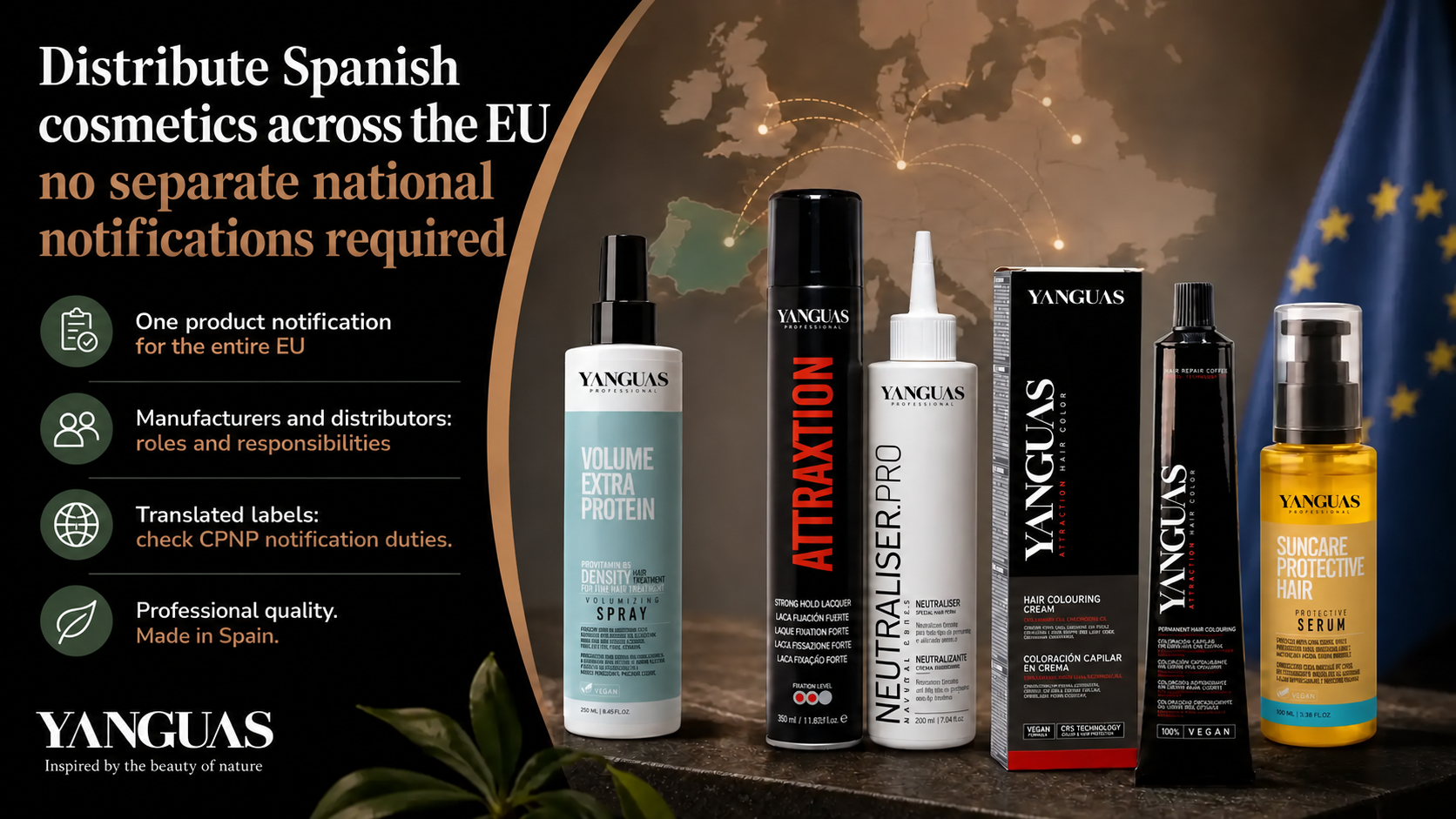
If you distribute cosmetics made in Spain in another European Union country, you do not have to register them again: the notification the manufacturer files on the EU's CPNP portal covers the whole single market. There is only one exception that affects you directly, and that is translating the labelling yourself.
One Notification for the Whole European Market
Before a cosmetic is sold in the EU, the product's responsible person notifies it on the CPNP, the European Commission's portal. That notification is a one-off. As the Commission explains on its CPNP page, once a product has been notified there is no need for any further notification at national level within the EU.
For a distributor in any other EU country, that makes the start a lot simpler. There is no country-by-country health registration and no customs between Member States: the product that leaves Tudela arrives in your warehouse with the same legal status it had in Spain.
Who Answers for the Product, and Who Does Not
The key figure in Regulation (EC) No 1223/2009 on cosmetic products is the responsible person. For a product manufactured in the EU, that is by default the manufacturer itself, which takes care of the formula, the safety assessment, the product file and the notification.
The distributor has a role too, but a different one:
| Who | What falls to them |
|---|---|
| Manufacturer (responsible person) | Formula, safety, file and CPNP notification |
| Distributor | Checking labelling, language and durability date |
| Distributor | Storing and shipping without harming it |
| Distributor translating on its own | Filing its own notification |
A distributor only becomes the responsible person if it sells the product under its own name or trademark, or modifies it in a way that could affect compliance. The regulation makes clear that translating the product information does not count as such a modification.
The Exception That Does Affect You: Translating the Labelling
Each Member State decides the language of the labelling, so selling in another country usually means labels in its language. This is where the distributor's only CPNP obligation of its own comes in:
A distributor who makes available in a Member State a cosmetic product already placed on the market in another Member State and translates, on his own initiative, any element of the labelling of that product in order to comply with national law, shall submit, by electronic means, the following information to the Commission.
The information is brief: the product category, its name in each country, the country where it is sold, your details and those of the responsible person. The key lies in the phrase on his own initiative. Before signing, it is worth clarifying with the manufacturer who prepares the labelling in your language, because that decides whether you have to notify or not.
What the Manufacturer Does So You Can Start Without Red Tape
Yanguas Professional formulates and manufactures in Tudela (Navarre), and its products are formulated under the European cosmetics regulation and notified on the CPNP. For distributors in other markets, it coordinates the labelling and technical documentation each country requires.
On top of that comes what regulation does not cover: contractual exclusivity by country, gradual onboarding of products, technical training for your network and sales material adapted to your market.
💡 Before ordering your first shipment: ask the manufacturer for the list of products notified on the CPNP and check which languages its labelling already covers. It saves work and tells you whether you will have to notify anything yourself.
If you distribute professional cosmetics in another European Union country and want to add a Spanish hair care brand, you can tell us about your market and company type on the Yanguas Professional international distribution page.