Exclusive Distribution Rights Are Earned Through Development Targets
To become the exclusive distributor of a brand, you need a contract that assigns you a territory, backed by purchase and development targets that justify it. The manufacturer grants that exclusivity according to the area's potential and your sales capacity, and in the European Union the law sets out what that contract can and cannot restrict.
What Does the Manufacturer Ask in Return for Exclusivity?
A manufacturer that reserves an area for a single distributor gives up selling there through other routes. In return, it needs assurance that the brand will grow in that territory, and that assurance comes from development targets: a commitment to purchasing and to building presence in salons, reviewed over time.
At Yanguas Professional, exclusivity is negotiated case by case, depending on the size of the territory, the market potential and the distributor's commercial commitment. The scope changes with the market:
| Market | Usual scope | Basis of the agreement |
|---|---|---|
| Spain | A province, a region or the whole country | Purchase and development targets |
| International | A country or an entire market | Contract with territory and targets |
What is not required is a minimum company size. The terms are designed for both self-employed agents and distribution companies, and what is adjusted in each case is the extent of the area and the targets attached to it.
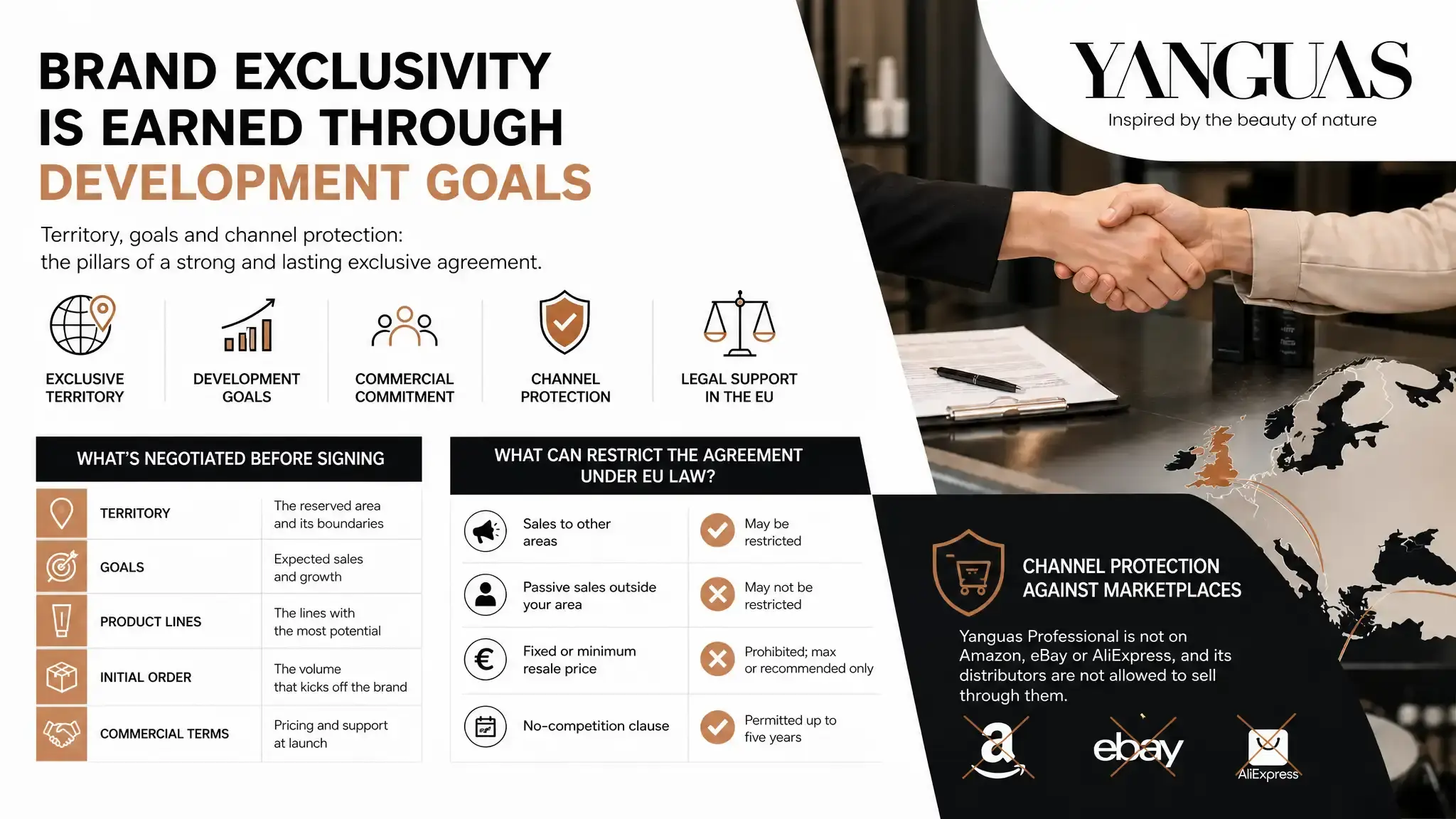
What Gets Negotiated Before Signing
An exclusivity contract rests on a handful of decisions, but each one shapes years of work. Five points are settled during the negotiation:
| Point | What is decided |
|---|---|
| Territory | The reserved area and its boundaries |
| Targets | Expected purchasing and development |
| Product families | The lines with most potential in your area |
| Initial order | The volume the brand launches with |
| Commercial terms | Pricing and launch support |
The choice of product families is the one most often underestimated. There is no need to start with the full catalogue: colour, bleaching, technical treatments and styling can be added progressively, starting with the lines that best fit the salons you already visit.
Minimum volumes do not follow a fixed table either. They are set after jointly assessing the area's potential, with the aim of growing sustainably rather than forcing orders that make no commercial sense.
What Can the Contract Restrict Under European Law?
Within the European Union, distribution contracts are governed by Regulation (EU) 2022/720 on vertical agreements, which exempts these agreements when neither the supplier nor the distributor holds more than 30% of the market. The regulation itself defines what an exclusive system is:
A distribution system where the supplier allocates a territory or group of customers exclusively to itself or to a maximum of five buyers and restricts all its other buyers from actively selling into the exclusive territory or to the exclusive customer group.
The key lies in the difference between active sales and passive sales. An active sale means seeking out customers in an area (visits, emails, targeted advertising); a passive sale means serving a customer who contacts you on their own initiative. The regulation lets your area be protected from the first, but not from the second:
| Clause | Treatment under the regulation |
|---|---|
| Others' active sales into your area | Can be prohibited |
| Your passive sales outside your area | Cannot be prohibited |
| Fixed or minimum resale price | Prohibited; maximum or recommended allowed |
| Non-compete obligation | Exempt for up to five years |
Outside the European Union, the framework depends on each country's law, but the points under negotiation are the same: territory, targets, range and terms.
Why the Brand Can Rule Out Marketplaces
A professional hair care brand loses value when it turns up discounted on a general marketplace, and the salons that sell it lose margin with it. That is why channel protection is part of the agreement: Yanguas Professional is not on Amazon, eBay or AliExpress, and its distributors cannot sell through them either.
European rules support this kind of clause. The Commission Guidelines on vertical restraints state that restrictions on the use of online marketplaces can generally benefit from the exemption, whatever the distribution system, provided they do not indirectly prevent the distributor from making effective use of the internet.
For you, as an exclusive distributor, that policy is a safeguard rather than a limitation: nobody can offer online, at a knock-down price, the same brand you are building up salon by salon.
💡 Tip before signing: ask for the contract to set out in writing the exact boundaries of the territory and how the targets are reviewed. That is what protects your investment if the market in your area changes.
If you want to explore exclusivity for your area or country, you can tell us about your company, your territory and your salon portfolio on the Yanguas Professional distributors page, and we will assess your market's potential together.