Distributing a Professional Hair Brand Starts With Your Salons
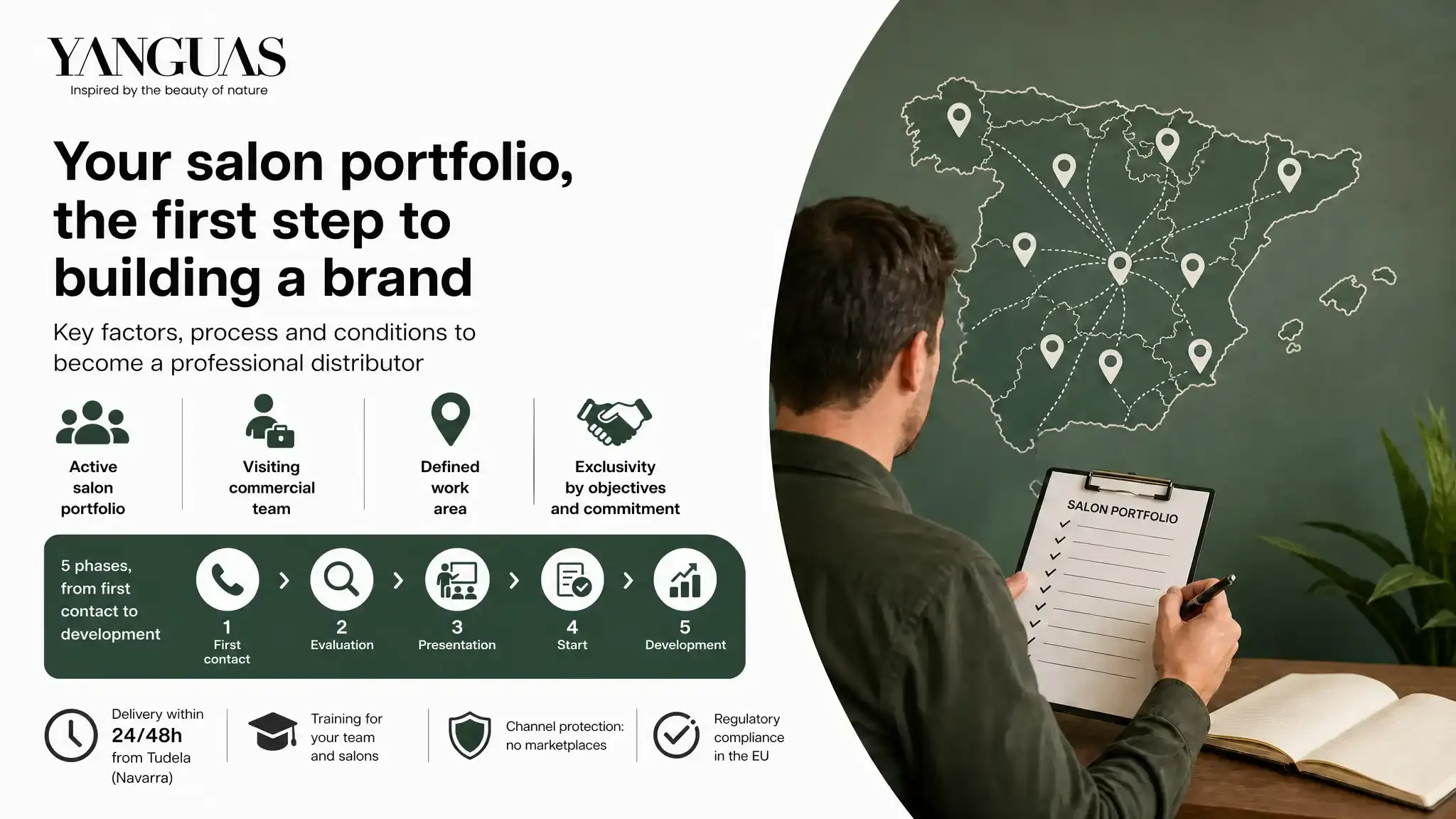
To become a distributor for a professional hair care brand, you need three things a manufacturer weighs before the first order: an active portfolio of salons, a sales team that visits them and a defined territory. Those are the basis for negotiating territory, purchase targets and exclusivity, in a five-stage process that runs from first contact to development.
What Does a Manufacturer Look for Before Trusting You With Its Brand?
A manufacturer that sells only to the professional channel is not after one-off orders. It wants someone who can establish the brand in the salons of an area and keep it there for years, so the first conversation turns on your salon portfolio, not on the size of your first order.
| Criterion | What is assessed | Why it matters |
|---|---|---|
| Channel experience | Your track record selling to salons | Technical products need skilled selling |
| Sales network | A team that visits salons | No visits, no market presence |
| Salon portfolio | Active clients and their profile | It is the real starting point |
| Territorial reach | The area or province you cover | It defines the negotiable territory |
| Current brands | What you distribute today | It shows range fit or conflict |
You do not need to be a large company. Yanguas Professional offers terms designed for both self-employed agents and local distribution companies: what changes with your size is the territory and the targets, not the way in.
The Five Stages, From First Contact to Partnership
The process is designed so that both sides decide on the basis of data. Each stage has a clear outcome, and much of it depends on what you bring.
| Stage | What happens | What you bring |
|---|---|---|
| 1. First contact | You present your company and area | Portfolio, experience and current brands |
| 2. Assessment | Your market presence is analysed | Your real sales capacity |
| 3. Presentation | You get to know the company and ranges | Your questions on range and positioning |
| 4. Start | Territory and terms are agreed | Your commitment to development |
| 5. Development | Joint follow-up in the salons | Visits, training and restocking |
The stage that decides the most is the territorial assessment. That is where your area's potential is weighed against your capacity to develop it, and that comparison produces the targets that later underpin exclusivity.
The presentation covers the brand's professional ranges: colour, bleaching, technical treatments and styling, with in-house technology such as CRS and Plex. It is the moment to check that the range fits the salons you already visit.
How Territory and Exclusivity Are Negotiated
Territorial exclusivity is not granted up front: it is earned through purchase and brand development targets. Its scope is matched to the size of the territory, the market potential and the distributor's commercial commitment.
- Scope
- provincial, regional or national
- Condition
- purchase and development targets
- Basis
- commitment and annual volume
- Negotiation
- case by case
Minimum volumes are not a fixed table either. They vary with the territory and the type of partnership, and they are set after jointly assessing the area's potential, with the aim of growing sustainably rather than forcing orders that make no commercial sense.
This kind of agreement has a clear legal framework in the European Union. Regulation (EU) 2022/720 on vertical agreements exempts distribution agreements from the ban on restrictive agreements, including exclusive distribution systems, provided that neither the supplier nor the distributor holds more than 30% of its market. It remains in force until 31 May 2034.
What Legal Obligations Do You Take On When Distributing Cosmetics?
When selling cosmetics in the European Union, a distributor has obligations of its own, separate from the manufacturer's. Regulation (EC) No 1223/2009 on cosmetic products sums them up in a principle of due care:
In the context of their activities, when making a cosmetic product available on the market, distributors shall act with due care in relation to applicable requirements.
In practice, that due care translates into specific checks before and after selling:
| Obligation | What the distributor checks |
|---|---|
| Labelling | That the mandatory information is present |
| Language | That labelling meets the language requirement |
| Durability date | That the minimum date has not passed |
| Storage and transport | That they do not jeopardise compliance |
| Cooperation | Providing documents if the authority asks |
The formula, the safety assessment and the product notification are the job of the responsible person who places it on the market. With a manufacturer that formulates, produces and notifies its products on the European CPNP portal, that part comes already handled, and your work focuses on checking, storing and selling.
What the Distributor Gets in Return
A professional brand lives or dies in the salon, and the salon needs training and reliable restocking. That is why support for the distributor weighs as much as the commercial terms:
- Training for your sales team: sales arguments, technical sheets and positioning.
- In-person or online training for the salons that take on the brand.
- Displays, signage and catalogues for the point of sale.
- Deliveries within 24/48h from Tudela (Navarre), with stable stock and no customs.
- Ongoing sales follow-up, with news, launches and promotions.
On top of that comes channel protection. Yanguas Professional does not sell on Amazon, eBay, AliExpress or any general marketplace, and its distributors cannot do so either. That protects your investment and the margin of the salons you sell to.
💡 Tip from the sales team: bring to the first conversation a list of the salons you visit by town and the brands they already use. That is what the assessment looks at, and it turns a generic enquiry into a territory proposal.
If you already work the salon channel in a specific area, the next step is to share your province, portfolio and team through the application for distribution in Spain, so we can assess your territory's potential together.