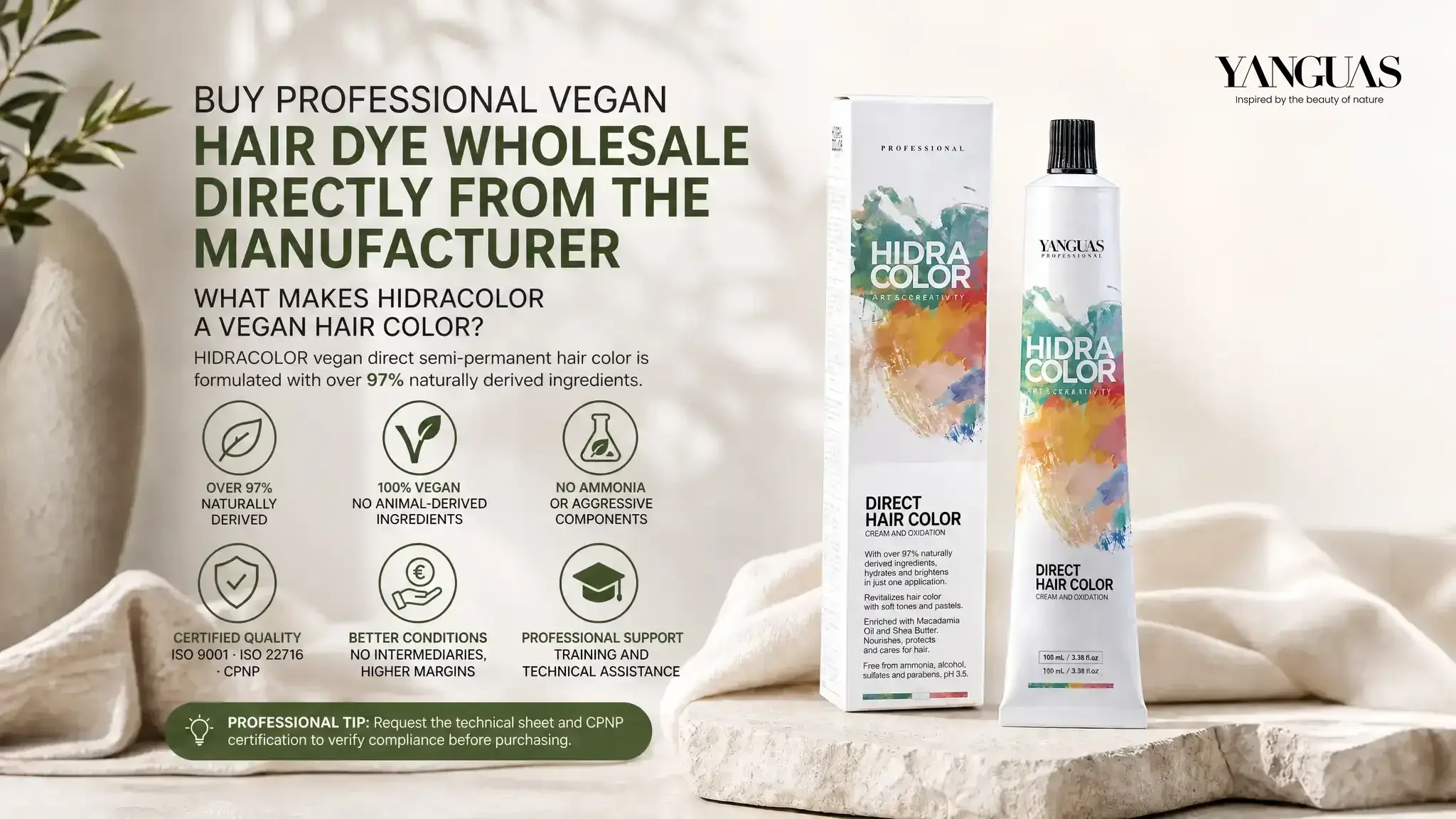
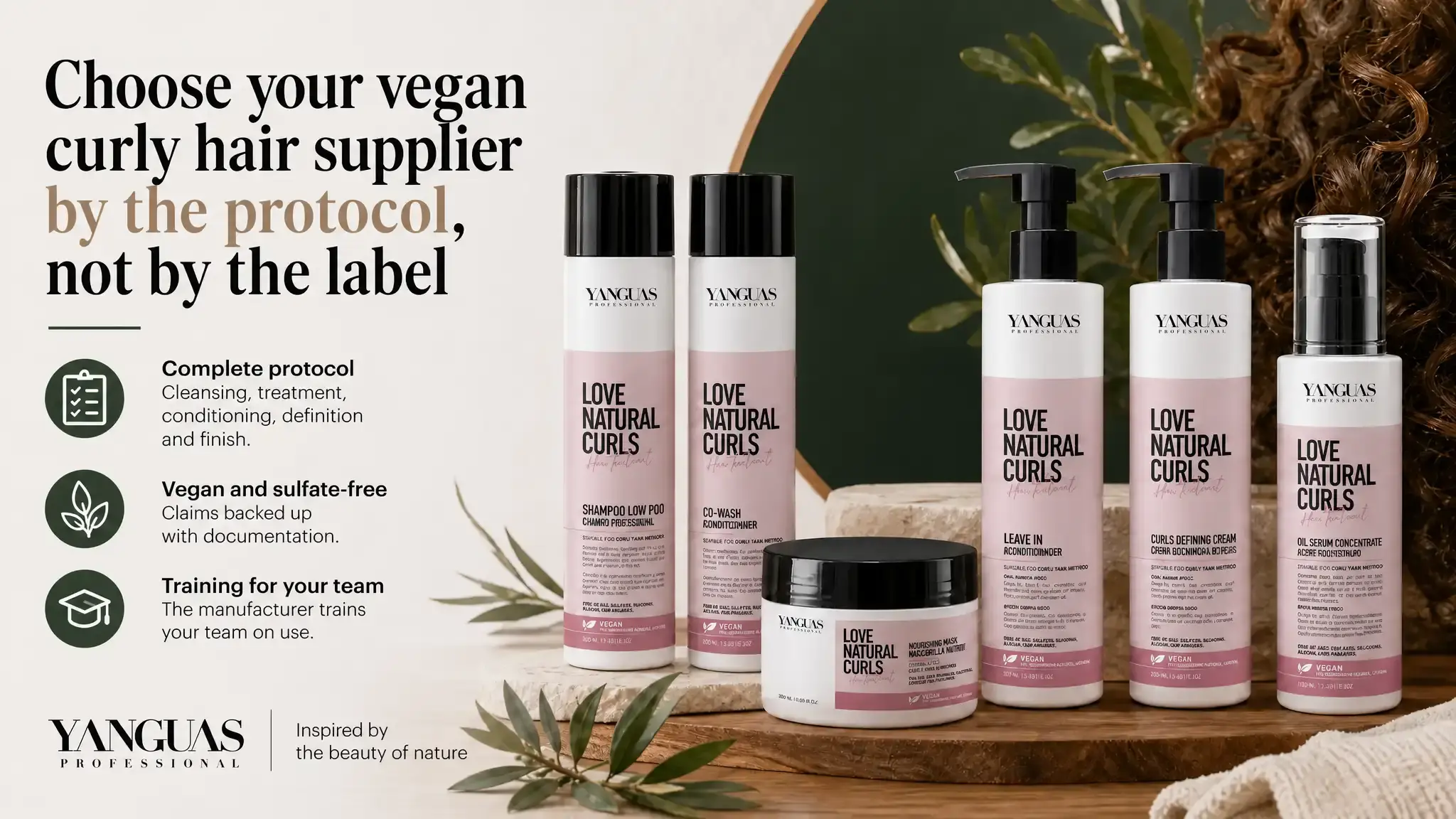
A vegan curly hair products supplier is right for your salon if its range covers the whole protocol, from cleansing to finish, if it can document what its label promises and if it makes what it sells and trains your team. A vegan label with no protocol behind it does not hold up a service the client wants to repeat.
What Protocol Should the Range Cover in the Salon?
The curly method is a sequence, and a service is only predictable if all its steps come from the same formula. When the supplier offers a sulfate-free shampoo and little else, the salon completes the routine with other brands, mixes formulation criteria and loses the ability to explain why the curl behaves as it does. The first thing to ask for is a complete protocol within a single range.
| Service step | What the supplier must provide | In Love Natural Curls |
|---|---|---|
| Cleansing | Two options, with and without lather | Shampoo and Co-Wash |
| Treatment | A mask with a set leave-on time | Professional Mask |
| No rinse | A conditioner that adds no weight | Leave-In Conditioner |
| Definition | A light-hold cream | Curl-Defining Cream |
| Finish | An oil for the ends | Concentrated Oil |
A serious supplier also explains when to use each format, rather than only selling it. Co-wash and shampoo, for instance, are not applied together: the service starts with one or the other depending on the client's scalp, and that decision has to be in the sheet or in the training.
How Do You Check That a Range Is Really Vegan?
In the European Union there is no legal definition of a vegan cosmetic. What there is, is the obligation that every claim on the label can be proven: Regulation (EU) No 655/2013 sets the common criteria those statements must meet.
Claims for cosmetic products, whether explicit or implicit, shall be supported by adequate and verifiable evidence regardless of the types of evidential support used to substantiate them, including where appropriate expert assessments.
The technical document on cosmetic claims agreed by the European working group on claims gives "free from animal-derived ingredients" as an acceptable example for products intended for vegans. The same document recalls that distributors also have a duty to act with due care in their activities, so the question about what the label says reaches the whole chain, not only the manufacturer.
In practice, ask for the technical sheet of each format and check that what the pack promises matches its ingredient list. Love Natural Curls is declared vegan and free from salts, sulfates, silicones, alcohol and parabens, with 95% of ingredients of natural origin, among them wheat protein, vegetable oils and shea butter.
Manufacturer or Reseller: What Changes for Your Salon
A supplier that manufactures controls the formula, the batches and the supply; one that resells depends on third parties for all three. To know which one you are dealing with, ask where each product is formulated and made. For Yanguas Professional, the answer is its plant in Tudela (Navarra), where it makes 100% of its products, from formulation to packaging, with its own R&D laboratory.
The second criterion is the professional channel. If the same curly range turns up discounted online, the client tries the service in your chair and buys the routine somewhere else; Yanguas does not sell on marketplaces and does not let its distributors do so. Your salon is served by the distributor for your area, which is also who brings you the orders and the sheets.
The Questions to Ask Before the First Order
Half an hour of conversation with the supplier saves months of adjusting the service. These are the questions that separate a range designed for the salon from a label with a good photo:
| Question | What answer to look for |
|---|---|
| Where is each format made? | A specific plant of its own |
| What documents "vegan"? | The technical sheet and the INCI list |
| Does the range cover every step? | Cleansing, treatment, definition and finish |
| Where else is it sold? | Only in the professional channel |
| Who trains the team? | The manufacturer itself, with a date |
If an answer comes back vague, ask again in writing. A manufacturer that knows its formula can answer each of them with a document.
What Training Should the Supplier Provide?
A five-step protocol only works if the whole team applies it the same way, and that takes technical training from whoever made the formula. Yanguas offers in-person or online training to salons that join the brand, and its Academy runs courses and Master-Classes with leading hairdressers all year round.
Training does not end with the course. The technical sheets and the advice of the Yanguas team settle everyday application questions, and the display stands and sample sachets help the client try the routine before she takes it home.
💡 Professional tip: before you put the range on the menu, run the full protocol on one client with dry curls and another with fine curls. It is the quickest way to check whether the definition holds without weighing the hair down.
When a client asks you why that range is vegan, answer with facts from the factory rather than the label: the Yanguas Green Beauty programme, with photovoltaic self-consumption at the plant, gives you those answers, and it is worth telling her that it is an in-house programme, not an external seal.