Where hair salons buy their professional products
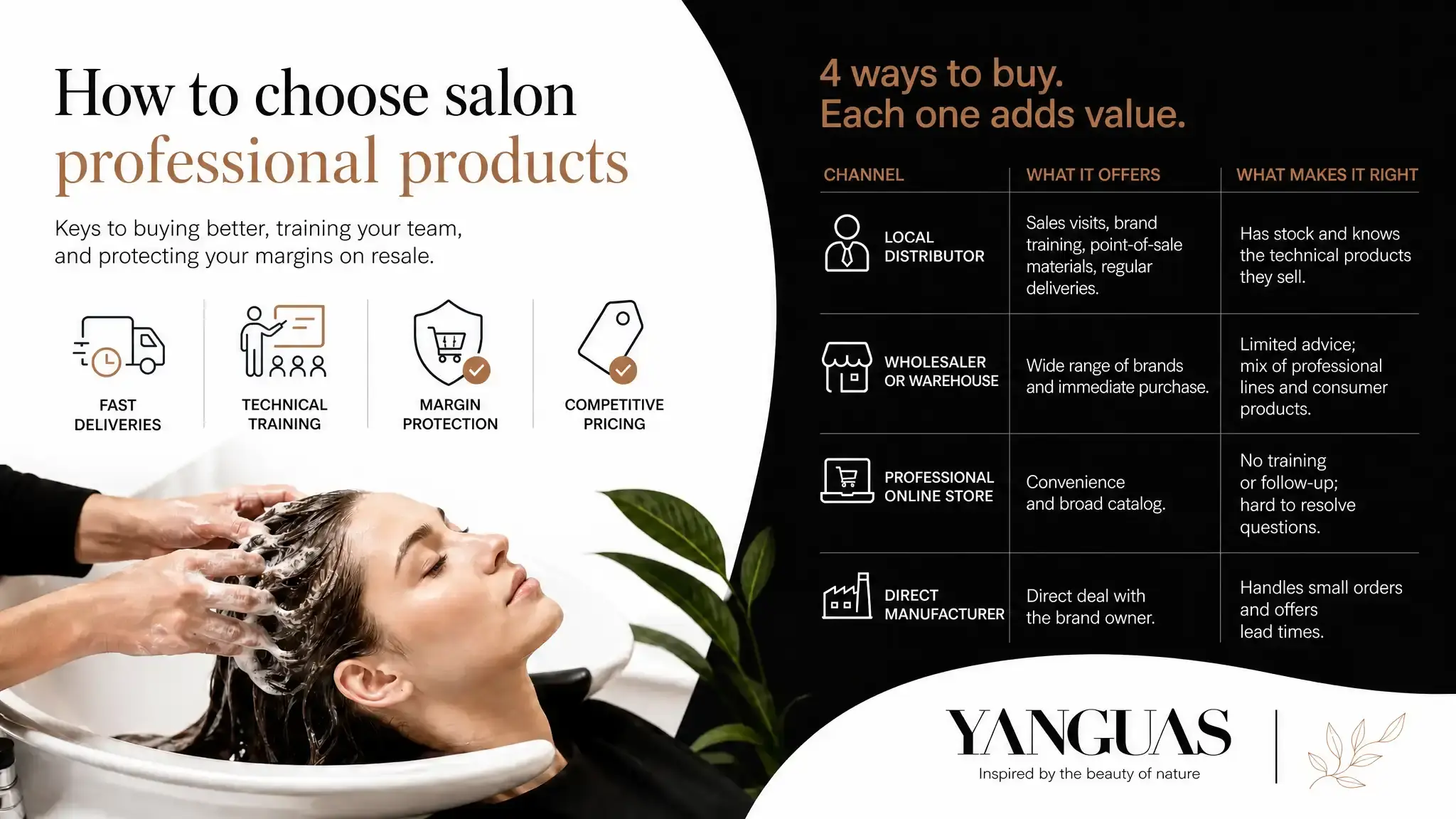
A hair salon buys its professional products through four channels: each brand's area distributor, the hairdressing wholesaler or warehouse that carries several brands, the online shop for professionals and, in some cases, the manufacturer itself. Each channel changes what the salon gets besides the product: delivery times, training, technical advice and, above all, whether that same product later appears online at a price the client can compare with the salon's.
Where can I buy hairdressing products wholesale?
The professional channel has its own buying points, and none of them looks like a perfumery or a supermarket.
The usual route for brands that work only with salons is the area distributor: a company that represents one or several brands in a province, a region or a country, with sales reps who drop by the salon, note what is running low and deliver it from their warehouse. Salons that prefer to buy when they need to, choosing among many brands, go to the hairdressing wholesaler, which gains in range and immediacy what it loses in support. The professional online shop is that same warehouse in digital form, handy for restocking what the team already knows by heart.
Manufacturers are less uniform. Some brands sell straight to the salon; others, although they formulate and make their own products, take orders through their distributor network and keep direct contact for technical support and training.
Outside the channel sit the general marketplaces, where anyone can find products with a professional label. For a salon they are more risk than opportunity, because whatever it buys there its clients can see too, at the same price or cheaper.
What changes between buying from the distributor, the wholesaler or the manufacturer
The unit price matters, but it rarely decides on its own. What separates one channel from another is everything that comes with the order:
| Channel | What it brings | What to watch |
|---|---|---|
| Area distributor | Sales visits, brand training, point-of-sale material, regular deliveries | Stable stock and real knowledge of the technical product it sells |
| Wholesaler or warehouse | A range of brands and immediate purchase | Little advice per brand; professional and consumer lines mixed |
| Professional online shop | Convenience and a wide catalogue | No training or follow-up; hard to solve an application question |
| Direct manufacturer | Contact with whoever formulates the product | Whether it serves small orders and how fast |
The difference shows most in colour and lightening. A dye or a bleach applied badly costs chair time and clients who do not come back, so technical training and having someone to ask when a mix does not reach the expected shade are worth as much as the product. Technical brands usually leave that part to the area distributor, who trains the team and comes back to the salon when the problem arises.
Retail products, the ones the client takes home, play by other rules. There the question is whether that shampoo or mask shows up online for less: if the client finds the same bottle cheaper on a marketplace, the salon loses the sale and some of the trust it put into the recommendation.
Which brands do hairdressers use?
There is no single list, but the brands seen on salon stations follow three models. Some formulate and manufacture their own products and sell only to salons and specialist distributors, with traceability, batch-to-batch consistency and channel protection as their arguments. Others are a distributor's or a group's own brands, made by third parties: they can work well, although the salon deals with whoever sells rather than whoever formulates. A third group lives in the salon, the supermarket and online at the same time, familiar to clients but with no protection at all for the retail margin.
Four questions help more than any catalogue when choosing among them. Who manufactures the product, and where? Is its quality system certified, for example to ISO 22716, the good manufacturing practice standard for cosmetics? Will it train my team? Is it sold outside the professional channel?
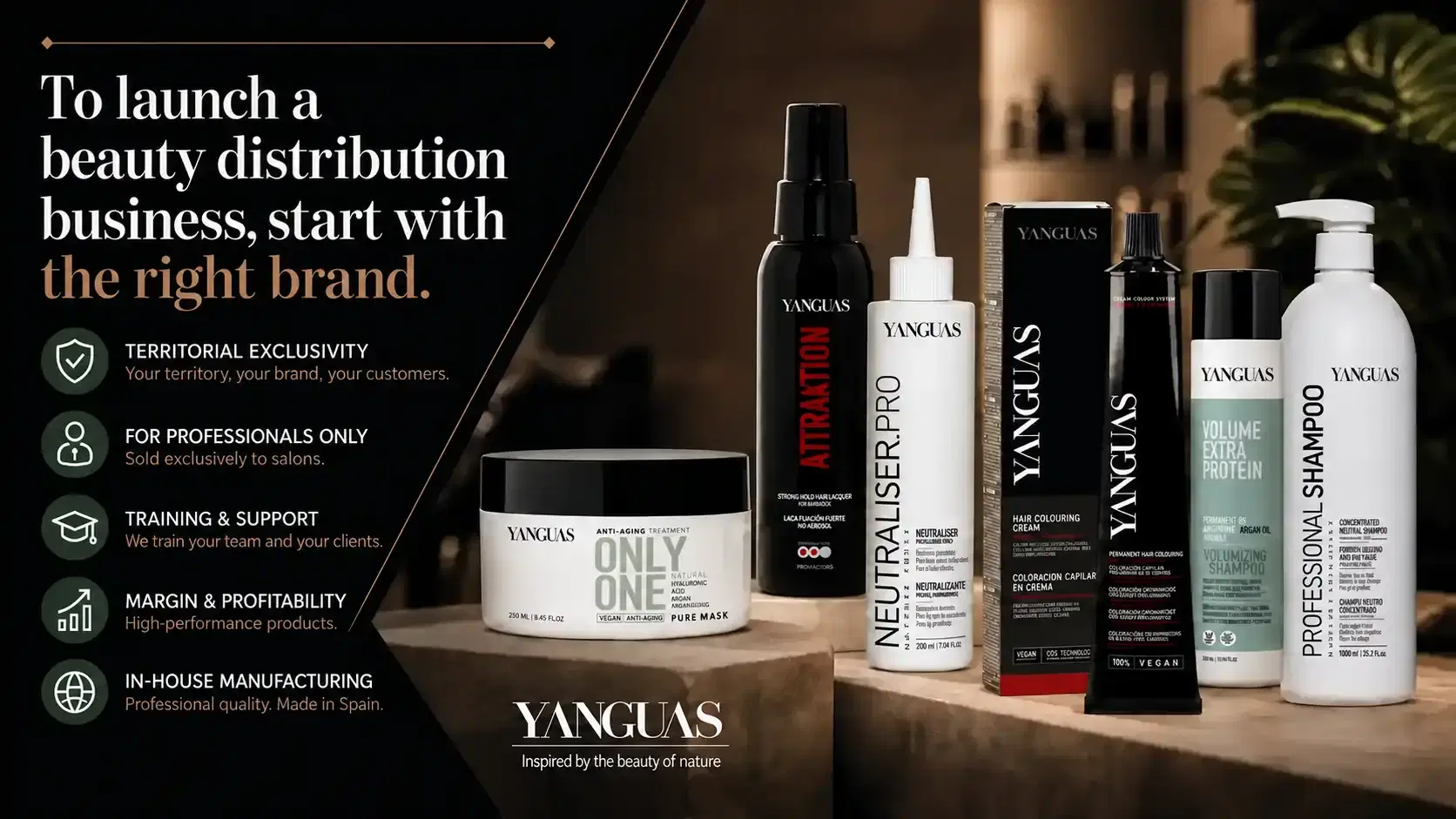
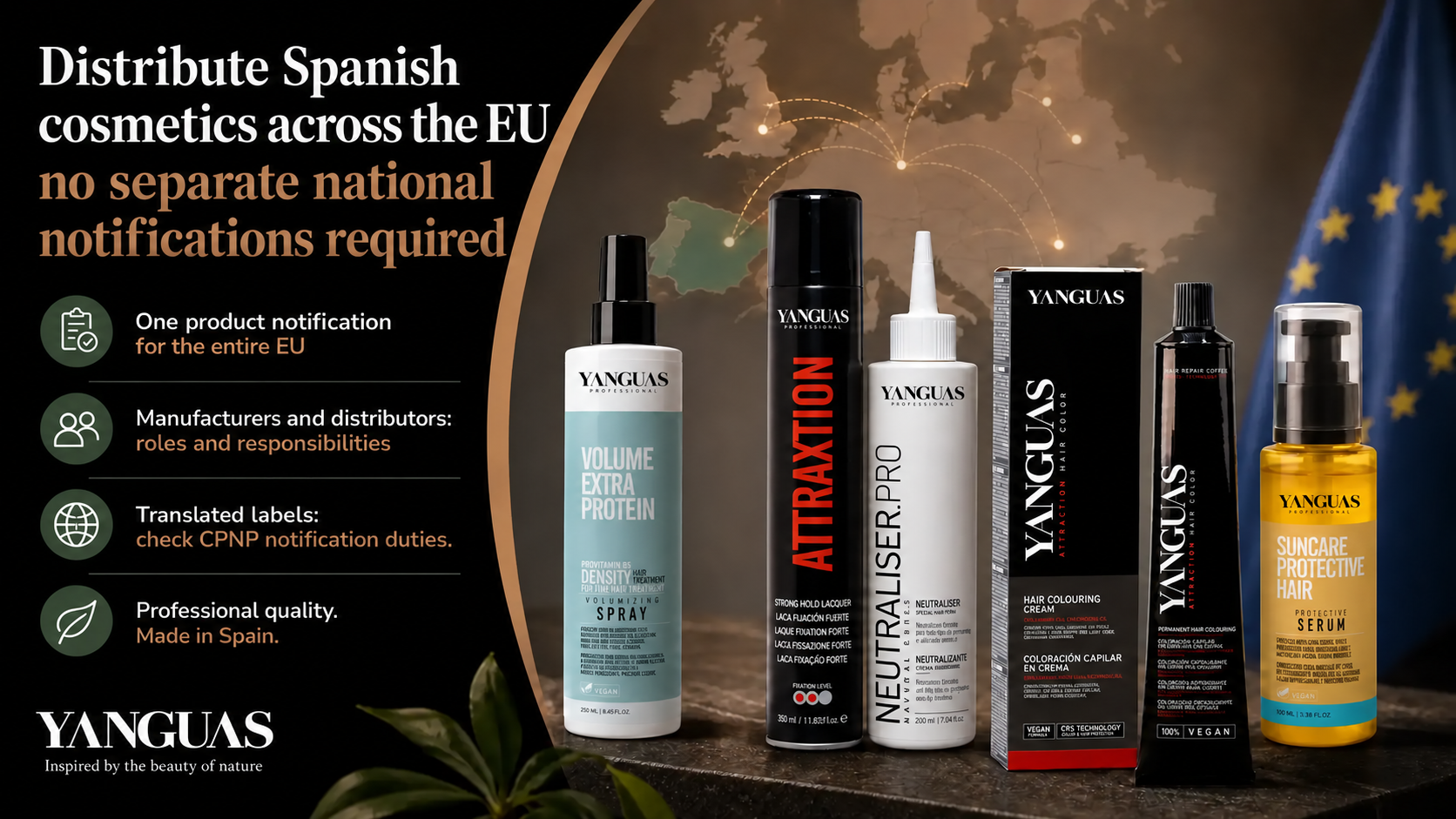
An example of how those questions are answered: Yanguas Professional has manufactured hair cosmetics since 1994 in Tudela (Navarre), with its own R&D laboratory and production and a quality system certified to ISO 9001 and ISO 22716, and it works only with the professional channel. It is not on Amazon, general marketplaces, supermarkets or consumer shops, which is exactly what protects the price of its retail products in the salon.
How to choose a supplier without losing margin
Before switching supplier or adding a brand, it pays to be clear on five things:
- Who looks after you, and how often. A distributor who visits regularly sees what is running out before it does.
- What training is included. A course when the brand comes in and a channel for application questions prevent costly colour mistakes.
- How long an order takes. A short lead time lets the salon work with less stock sitting idle.
- Where else the brand is sold. If it is on marketplaces or in consumer shops, your retail competes with a price nobody in the salon controls.
- What point-of-sale material it brings. Displays and samples let clients try before they buy, without the recommendation sounding like a hard sell.
With those answers in front of you, the unit price compares differently: it is no longer the price of a bottle but of everything that comes with it.
What to do if your salon wants to work with a manufacturer's brand
Start by asking the brand who serves your area, because almost every brand that protects its channel works through distributors. At Yanguas that is its network of professional distributors, who know each area and serve salons quickly, while the manufacturer stays close with technical sheets, advice on application questions, Yanguas Academy courses and master classes all year round, and displays and sample sachets for the point of sale.
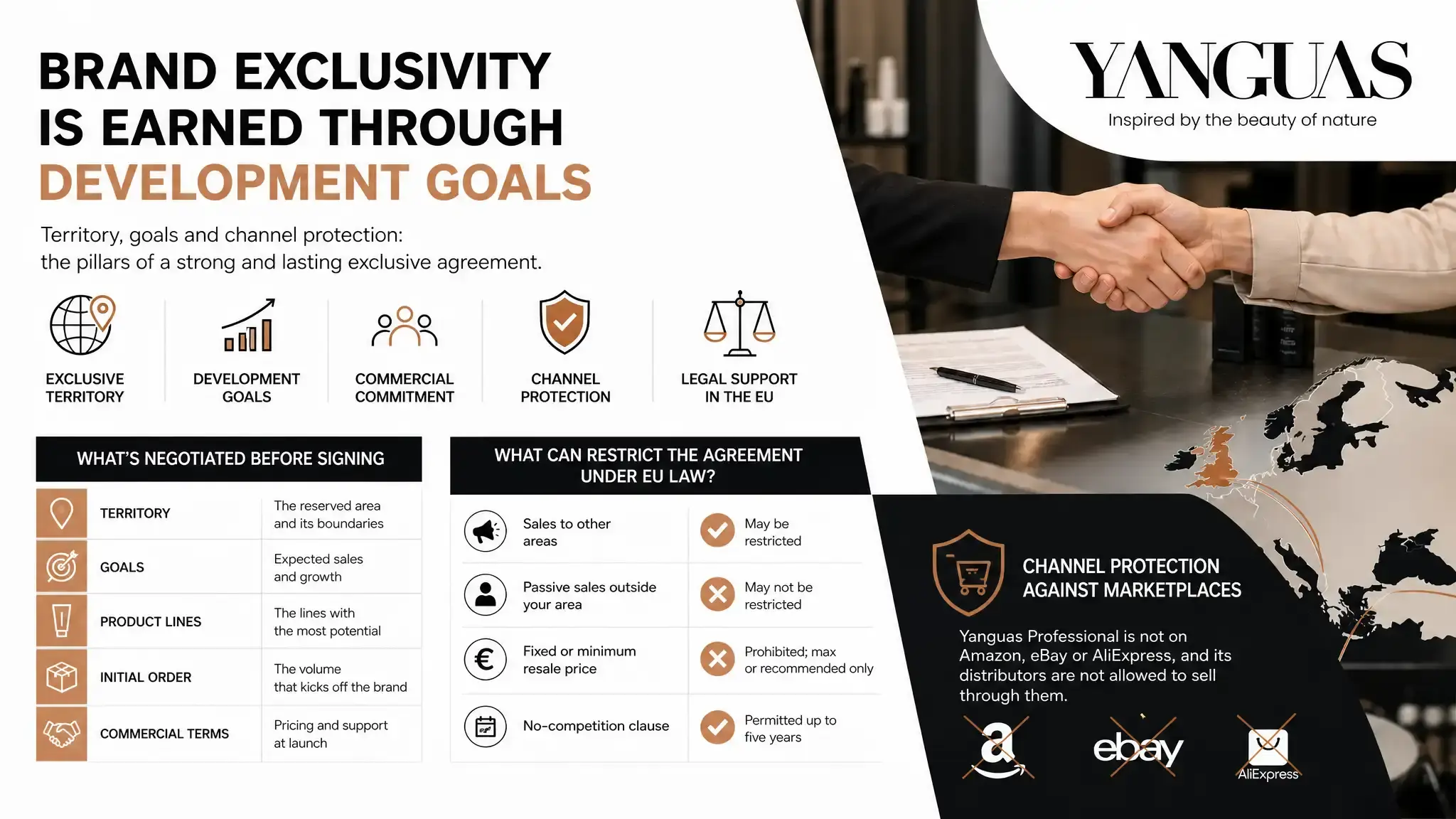
If your salon does not work with them yet, the step is as short as asking to be put in touch with the distributor for your area. And if what interests you is the other side of the counter, distributing a hairdressing brand, Yanguas is looking for professional distributors in Spain and abroad, with territorial exclusivity negotiated case by case, 24 to 48 hour logistics in Spain and training for the sales team and its salons.