Men's Hair Cosmetics in the Professional Salon: From the Haircut to the Recurring Ticket
Men have been entering the salon for years with a mental list of problems that no one asks them about: hair loss, oily scalp, gray hair they don't know whether to cover, hair without body after the cut. They leave with a haircut and little else.
Meanwhile, male grooming is growing steadily. The question is whether your salon seizes that opportunity or leaves it on the supermarket shelf. This article is not about aesthetic trends: it is about business, protocol, arguments, and professional products.
Key Takeaways
Before going into detail, these are the ideas that underpin the entire approach to male service in the salon.
Why is the Man Still the Most Underserved Salon Client?
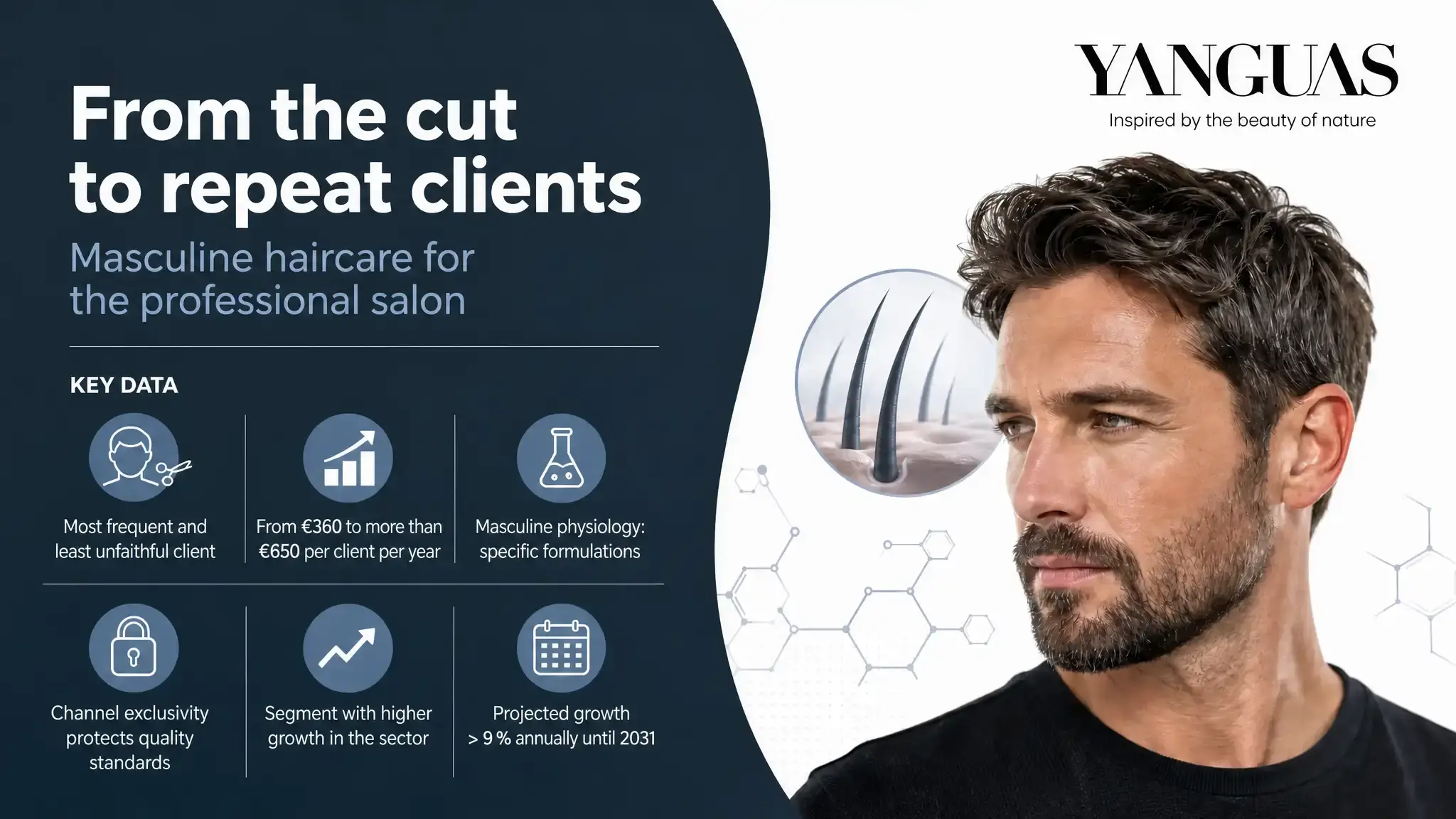
The paradox is striking. Men visit the salon more frequently than women in terms of haircuts, but generate less income per visit. Not because they spend less, but because the salon offers them nothing beyond the cut.
There are historical reasons. For decades, men's hairdressing was structured around fast service: cut, razor, finishing product. Hair diagnosis and consultative selling were perceived as something foreign.
But the client has changed. The generation that is today between 30 and 50 years old already buys men's cosmetics online and uses scalp serums. The premium male care segment is growing at a rate close to 7% annually, according to Grand View Research, a sign that men are not looking for the cheapest option: they are looking for what works.
The problem is not demand. The problem is that most salons do not have a structured protocol for that client or a set of arguments that justifies the price of advanced services.
What Does the Male Client Really Want When He Comes to the Salon?
Listening to the client before designing any service is the step most salons skip. If you ask, what you find is quite clear.
Anti-hair loss and density are the number one concern for adult men. The problem usually begins between 25 and 40 years of age, and many have already tried some pharmacy treatment without results. They arrive with distrust, but willing to listen if the professional speaks with rigor.
Scalp control is another frequent complaint. Androgenic hormones such as testosterone and dihydrotestosterone stimulate sebum production, which explains why the male scalp requires specifically formulated products and not the same solutions as female clientele.
Gray hair management requires guidance, not just product. There are those who want discreet full coverage, those who prefer to blend without altering the tone, and a growing proportion who just want their gray hair to look good. Each profile requires a different technique.
💡 Specialist's Tip: In the first visit, dedicate four questions to the scalp before touching the scissors. The type of sebaceous secretion defines whether the client is a candidate for a sebum-regulating treatment or a density treatment, and that initial reading already justifies the jump in service price.
How to Build a Male Service Protocol That Works
A protocol is not a list of steps. It is a structured experience that the client can anticipate, value, and recommend. It must be repeatable and transferable to the entire team.
The initial diagnosis is the foundation: four or five questions about scalp type, detected problems, home routine, and expectations. Trichoscopy is not needed to start; the will to ask is needed.
The second pillar is a differentiated service menu, with its own categories, name, price, and understandable technical description.
| Service | Content | Duration |
|---|---|---|
| Express | Haircut + scalp treatment | 45 min |
| Anti-hair loss | Diagnosis + densifying actives | 60 min |
| Men's Color | Coverage or gray blending | 45 min |
| Deep Hydration | Fiber repair ritual | 50 min |
The third pillar is an accessible technical argument. The professional must explain what the applied product does without unnecessary technicalities. "This shampoo regulates sebum because it acts on the follicle" is more convincing than "it's very good for oily scalps."
The proposal for home continuity closes the circle. Maintenance sales not only improve income: they improve the result the client perceives and accelerate their next visit.
What Product Line Does the Salon Really Need?
Not just any range will do. There are physiological differences that justify specific formulations and an important commercial difference: the product must be out of reach of the final consumer on the mass market shelf.
Scalp care is the foundation of any density treatment. Shampoos with sebum-regulating, exfoliating, and microcirculation-stimulating actives must be worked on before acting on the fiber, as proposed by the professional channel hair treatment line.
Anti-hair loss and densification require serums, ampoules, and lotions with proven actives. The professional must know the mechanism of action of what they apply, something that connects directly with hair epigenetics applied to anti-hair loss actives.
Discreet coloring is one of the fastest-growing and simultaneously least-penetrated segments. The client wants natural results, and blending techniques, translucent glosses, and gradual coverage require specific coloring products and training.
The professional styling range completes the offer: waxes, pastes, and clays with textures that the client cannot replicate at home. It is one of the easiest sales vectors because the difference is noticed immediately.
Male Service as a Lever for High Tickets
A client who comes every three weeks for a haircut generates many visits. The challenge is to increase the value of each one without lengthening their time in the salon or forcing services they don't need.
The math is simple, as shown by the comparison between the haircut-only client and the same client with a structured service.
| Client Profile | Annual Services | Revenue/Year |
|---|---|---|
| Haircut only | 18 cuts at 20 € | 360 € |
| Structured service | Haircut + anti-hair loss + maintenance + color | more than 650 € |
The underlying data supports the bet. According to the sector report by Mordor Intelligence, the male segment is the fastest-growing in the salon sector, with a projected growth rate exceeding 9% annually until 2031. It is not a marginal niche: it is a client who is already in the salon and under-exploited.
Loyalty also has an advantage: when a man finds a professional he trusts, he tends not to change salons. Someone who has gone through a well-conducted consultation and obtained visible results is, statistically, the most loyal client, because he values certainty.
What Really Sets a Salon Apart in the Male Segment?
The answer is not just the product or just the technique. What makes the difference is the combination of three elements that rarely appear together.
The first is technical credibility: the team knows what they are talking about when treating hair loss, the scalp, or actives. This is achieved with training, written protocols, and a range with real technical documentation behind it.
The second is an experience consistent with the client's profile. There is no need to set up a barbershop inside the salon; the client needs to feel that the service is designed for him, from the initial consultation to the follow-up.
The third is product exclusivity. When the client can buy the same shampoo applied in the salon on a marketplace, the quality argument falls apart. Working with exclusive professional channel brands is structural to the business model.
Frequently Asked Questions
Is it worth structuring a male service in a small salon?
Yes. The advantage of the male segment is that the client is already in the salon and comes frequently. It does not require new acquisition or additional equipment, just reordering the service with diagnosis, a differentiated menu, and continuity products.
Why can't I use the same range as for female clientele?
Because physiology differs. Androgenic hormones stimulate sebum production more, and the male scalp usually needs a different sebum-regulating approach. Furthermore, professional channel products protect exclusivity against the mass market shelf.
Do I need diagnostic equipment to start?
Not to get started. A diagnosis of four or five targeted questions about the scalp, routine, and expectations already establishes the bond of trust and justifies part of the price. Trichoscopy is a later step, not an entry requirement.
How do I justify the price of a treatment compared to the supermarket?
With an accessible technical argument. Explaining the mechanism of action of the active ingredient and working with exclusive channel products makes the client perceive a value they cannot find in the mass market.
Is the male client loyal once the service is structured?
He tends to be. When he finds a professional he trusts and obtains visible results, a man rarely changes salons, because he values certainty and continuity over novelty.