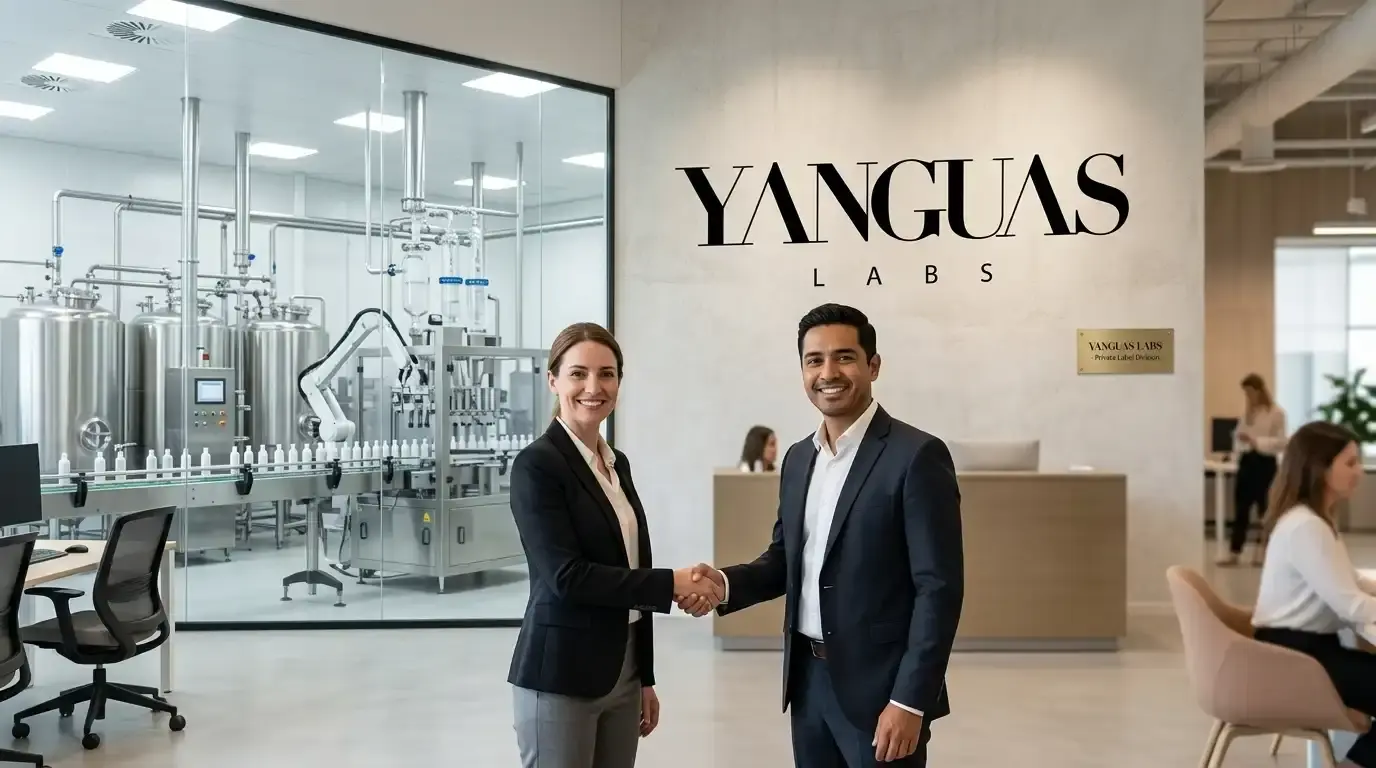
A salon launches its own hair cosmetics brand by commissioning a specialized private label manufacturer for the formulation, production, and regulatory registration of products, which are then marketed under its own name and packaging. The model requires a manufacturer certified in ISO 9001 and ISO 22716, with the capacity to handle the CPNP notification process and minimum volumes adjusted to the salon's actual consumption.
What Differentiates Private Label from Reselling a Third-Party Brand
In private label, the salon controls the product identity: name, packaging, positioning, and range, within the formula bases offered by the laboratory. The manufacturer provides the formulation, quality control, and industrial production; the salon provides the brand and the sales channel.
This is different from reselling a third-party brand, where the salon has no influence over the price, packaging redesign, or the continuity of references. With an own brand, those decisions remain in the hands of the salon.
What Volume and Structure a Salon Needs to Launch Its Own Brand
The model makes sense when three conditions are met simultaneously: a sufficient internal consumption volume to amortize manufacturing minimums, a brand with local notoriety that the customer perceives as valuable, and a team capable of managing stock, rotation, and staff training.
Chains with several centers, high-ticket salons with loyal clientele, and training academies usually fit this profile well. An individual salon with low traffic will hardly amortize the initial investment if it launches the brand too soon, before having a consolidated customer base.
What Phases the Development of an Own Brand Goes Through
The process, when well executed, goes through several technical and creative stages before reaching the salon shelf.
- Strategic definition
- audience, positioning, and number of initial references
- Formula selection or development
- within the laboratory catalog or custom-made
- Visual identity
- name, packaging, labeling, and point-of-sale materials
- Regulatory
- safety assessment, PIF file, and CPNP notification
- Production
- manufacturing, packaging, and batch release
The regulatory part is not optional: every cosmetic reference marketed in the European Union needs a responsible person, a product information file, and its corresponding notification before going on the market.
What Certifications the Manufacturing Laboratory Must Have
The choice of laboratory is the decision that most influences the final result. The criteria that make a difference are five: quality certifications, in-house R&D technical capacity, specialization in the professional channel, full batch traceability, and flexibility in minimum volumes.
- ISO 9001
- quality management of the manufacturing process
- ISO 22716
- Good Manufacturing Practices for Cosmetics (GMP)
- CPNP
- mandatory notification of each reference in the EU
- Traceability
- batch number and documentation per production
💡 Manufacturer's tip: demand that the laboratory assumes or accompanies the role of responsible person before European regulations; delegating only the packaging without that support leaves the salon exposed to the entire administrative burden of the launch.
What Margin and Profitability It Offers Compared to Buying from a Distributor
By manufacturing directly, without intermediate distribution layers, the salon eliminates the margin that a distributor normally keeps between the laboratory and the point of sale. These savings are passed on both to the product sold at the counter and to what is consumed internally in each coloring service or treatment.
Real profitability depends, however, on rotation: a range that is too wide with slow turnover ties up capital and reduces the theoretical profit of the model. Therefore, it is advisable to start with a few well-chosen references before expanding the own catalog.
Yanguas Professional is a Spanish manufacturer of professional hair cosmetics since 1994, with its own R&D laboratories and production plants certified in ISO 9001 and ISO 22716. It develops manufacturing projects for third parties in coloring, bleaching, technical treatments, and styling, accompanying salons and chains in manufacturing for third parties from formulation to the regulatory registration of each reference.