
How Private Label Natural Hair Cosmetics Work
Yes, it is possible to manufacture natural hair cosmetics with a private label. A manufacturer with its own laboratory formulates custom products, selects ingredients of natural origin, personalizes the packaging with your brand, and registers each reference in the European Cosmetic Product Notification Portal (CPNP) before commercialization. The result is your own range, ready to be sold to the professional channel.
What Does "Natural" Mean in Hair Cosmetics?
"Natural" does not have a single legal definition in the European Union. Regulation (EC) 1223/2009 on cosmetic products regulates safety, labeling, and permitted substances, but it does not establish an official threshold for naturalness. According to the General Council of Pharmaceutical Colleges, "there is no official European regulation that defines what a natural or organic cosmetic is: each certifier establishes its own criteria."
In practice, the manufacturer and the client define the level of naturalness of the formula together. Common parameters include the percentage of ingredients of natural origin, the absence of specific substances (sulfates, siliconas, parabens, synthetic dyes), and compliance with market-recognized standards such as COSMOS or NATRUE. The more restrictive the criteria, the more limited the palette of active and functional ingredients available becomes.
💡 Technical advice: Before establishing your brand's "natural" positioning, define with the laboratory which exclusion criteria you will apply (list of prohibited INCI, minimum percentage of natural origin, compatibility with the Curly Girl Method, veganism) and ensure that these criteria are verifiable on the label. Promises that cannot be supported by the INCI list damage the brand's credibility.
The Regulatory Framework for All Private Label Cosmetics
Regardless of the "natural" positioning, every cosmetic product marketed in the European Union is subject to the same regulatory framework. The main requirements are:
| Requirement | Legal basis | Managed by |
|---|---|---|
| CPNP Notification | Art. 13 of Regulation (EC) 1223/2009 | The manufacturer or the responsible person |
| Good Manufacturing Practices (GMP) | Art. 8 of Regulation (EC) 1223/2009 and ISO 22716 standard | The manufacturer |
| Product Safety Report | Art. 10 of Regulation (EC) 1223/2009 | Qualified safety assessor |
| Product Information File (PIF) | Art. 11 of Regulation (EC) 1223/2009 | The manufacturer |
| Compliant Labeling | Art. 19 of Regulation (EC) 1223/2009 | The manufacturer and the brand |
Working with a manufacturer certified in ISO 22716 (Cosmetic Good Manufacturing Practices) is the recognized way to demonstrate compliance with the GMP required by the Regulation. This provides the private label client with the assurance that every batch is released with full traceability and physical-microbiological analysis prior to release.
The Stages of a Natural Private Label Project
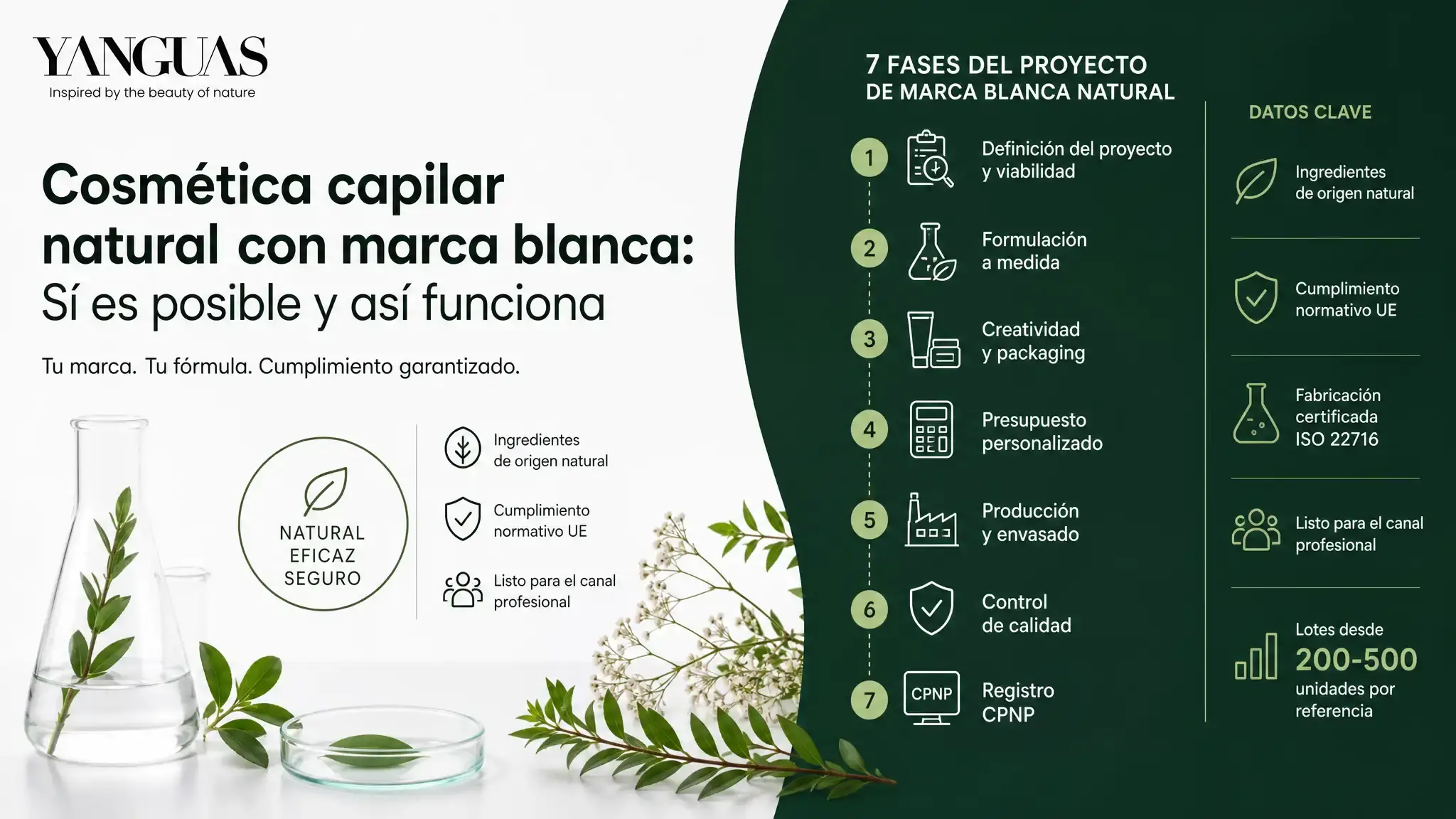
A well-structured project goes through seven phases that the laboratory manages from start to finish:
- Project definition and feasibility: the natural positioning is defined (exclusion criteria, target user, sales channel) and it is validated that the planned formula is technically feasible.
- Custom formulation: the laboratory develops the formula with active ingredients of natural origin chosen according to the briefing, until client validation is reached.
- Creativity and packaging: graphic design, container selection, commercial and legal texts adapted to the Regulation.
- Personalized quote: cost per unit based on production volume, formula complexity, and type of packaging.
- Production and packaging: manufacturing in own facilities under certified GMP conditions.
- Quality control: physical and microbiological controls of the batch before its release.
- CPNP Registration: official notification of each reference to the European portal before commercialization.
What Types of Natural Hair Products Can Be Developed?
The answer depends on the laboratory's formulation catalog and the agreed level of naturalness. The most common categories in hair cosmetics with natural positioning are sulfate-free shampoos, silicone-free conditioners, masks with vegetable oils and botanical actives, hair serums with biotechnological hyaluronic acid, anti-hair loss treatments with vegetable actives, and specific lines for curly hair (salt-free, alcohol-free, vegan).
A manufacturer with a broad portfolio of formulations can adapt already validated references or develop new formulas from scratch. The second option involves a greater investment in time and development but allows for a greater competitive advantage over other private labels on the market.
What Are the Standard Minimum Production Volumes?
Production minimums vary depending on the manufacturer, the type of product, and the packaging. As a general guideline, private label projects in natural hair cosmetics most frequently start with batches of between 200 and 500 units per reference, although actual minimums are set by each laboratory according to its cost structure and the complexity of the formula.
Before committing to a number of references, it is advisable to narrow down the initial catalog: launching three or four products with robust formulas and coherent packaging generates a better return than spreading the investment across a wide range with low volume per reference.
Understanding Formula Ownership and Exclusivity
Two contractual aspects must be clear from the beginning. Formula ownership can belong to the manufacturer (the client buys the right to use it) or it can be transferred to the client (the laboratory develops it exclusively and does not market it to third parties). The second option involves a higher investment in development but protects the brand's uniqueness.
Territorial exclusivity is equally relevant for brands operating in a professional channel: it is advisable to agree on whether the same laboratory can manufacture that product for another client in the same market. A well-drafted contract at this stage prevents future conflicts.
If your project targets the professional hairdressing and aesthetics channel, details of the full product development process are available at Yanguas Professional Product Development, where you can start a feasibility study without obligation.