How to Choose a Reliable Professional Hair Color Brand
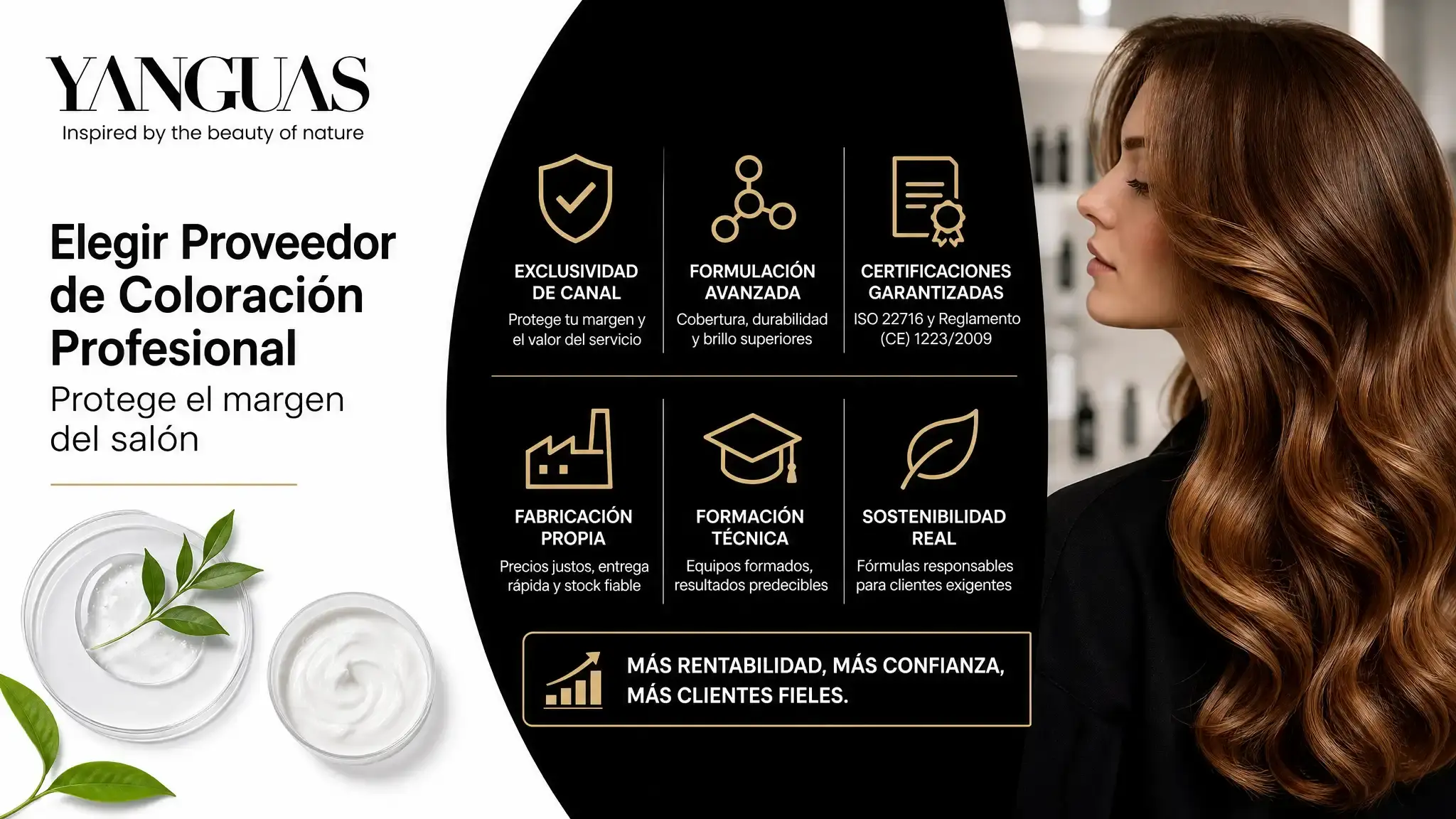
The hair color brand a salon works with is not just a technical matter: it is a business decision that affects its margin, its positioning, and customer trust. Choosing the right color supplier determines whether the professional is perceived as an expert or as a simple applicator of a product that anyone can buy online.
This analysis brings together the criteria that should guide that choice—from formulation and color charts to channel exclusivity, training, and sustainability—to make a decision that protects the business as well as the results.
Key Takeaways
The essentials for choosing a professional hair color brand that protects your salon, summarized in five keys:
Why the Color Brand Defines Salon Success
Many salon owners underestimate the strategic impact of the hair color brand they work with. The issue is not only whether the dye covers well or if the color lasts. It is deeper: the brand chosen defines the positioning, the commercial margin, and the relationship of trust with the client.
The most frequent mistake is discovering it too late. A salon invests in training, product, and communication, and one day a client walks in with their phone in hand saying they have seen that same dye at half price in a department store. At that moment, the professional's work and credibility are called into question.
Choosing a hair color supplier is not a technical decision, but a business decision. And like any business decision, it requires clear and verifiable criteria before committing.
Differences Between Mass-Market and Professional Dye
The gap between a supermarket dye and a professional one is not explained by price alone. Professional formulation responds to different demands: pigment concentration, pH control, compatibility with oxidants of different voltages, and predictable coverage on all hair types.
Mass-market dyes are designed for anyone to apply at home with an acceptable result. Professional ones, on the other hand, require technical knowledge to deploy their full potential: training, precise dosing, and prior diagnosis.
When a client can buy "the same dye" in a marketplace or a department store, the perception of the service's value plummets. The professional stops being an expert to become an applicator, and price becomes the only argument.
💡 Professional tip: before incorporating a range, confirm that it is not available to the final consumer in any online channel; exclusivity is what sustains the perceived value of your service.
Coverage, Durability, and Shine: the Three Key Parameters
To technically evaluate a coloring range, three parameters define its real quality in the salon's day-to-day. The first and most critical is gray coverage: a dye that fails on gray hair generates complaints, unpaid re-visits, and loss of trust. High-performance formulas must guarantee total coverage from the first application, even on resistant or porous hair.
The durability of the color determines the interval between visits. A color that loses vibrancy before four weeks forces more frequent visits—something seemingly positive—but creates a perception of low quality that, in the long run, pushes the client to seek alternatives.
Shine is the immediate aesthetic indicator: what the client perceives as soon as they look in the mirror. Formulations with natural oils, film-forming agents, and nourishing active ingredients provide that luminous finish that differentiates technical coloring from a generic dye. A range like Attraxtion, the permanent cream coloring, integrates these criteria with its fiber protection system during oxidation.
Color Chart and Shade Versatility
A complete and coherent color chart is not a catalog: it is a daily work tool. The more chromatic resources the stylist handles, the greater their ability to personalize the result and build loyalty with each client.
Good professional charts organize tones with a logical numbering that facilitates mixing, toning, and correction. A universal numbering system—base plus reflect—allows for consistent work even when there is staff turnover in the team.
Versatility is also compatibility. A well-designed range allows for creating custom mixes, working on gradients, and adapting the result to trends without changing suppliers every season. Mastering color theory and the shade chart, along with a rigorous prior diagnosis, is what separates a truly professional result from an improvised one.
Active Ingredients and Hair Health
The formulation of a modern professional dye goes far beyond the pigment. The active ingredients that accompany the coloring determine the state of the hair after the service, and that state is precisely what the client sees and touches when leaving the salon. Today's most relevant technologies respond to that double demand for color and care.
| Technology | Main function |
|---|---|
| Plex Technology | Protects hair bonds during the chemical process; key in bleaching and intensive lightening |
| Hair epigenetics | Acts at a cellular level on the mechanisms of long-term hair regeneration and health |
| Plant stem cells | Natural active ingredients that promote fiber regeneration and resistance against aggression |
| Low ammonia content | Maintains coverage and fixation while reducing olfactory impact and scalp aggression |
Current coloring no longer just dyes: it can improve the hair while coloring it. A formula like the ammonia-free permanent cream coloring illustrates this approach, combining coverage effectiveness with fiber nutrition. Brands that do not integrate this technical philosophy are progressively displaced from the professional market.
Training, Profitability, and Stock Management
A brand that only sells product is a supplier; one that trains your team is a partner. Technical training is the most undervalued asset in the relationship between a color brand and a salon: when the team masters the times, proportions, and interactions of a range, results are predictable, waste decreases, and client confidence grows. Brands that invest in training bet on the salon's profitability, not just their own turnover.
The profitability equation is not decided at the counter either, but when choosing a supplier. Working directly with the manufacturer eliminates middleman margins and gives access to high-level technical ranges at coherent prices, which translates into more margin per service or more competitiveness in rates.
Stock management equally depends on that choice. A brand with in-house manufacturing in Spain guarantees short lead times, supply stability, and responsiveness to unforeseen events, without depending on distant imports. A comprehensive catalog—coloring, bleaching, treatments, and styling—also allows for centralizing orders with a single supplier and gaining operational efficiency.
Reputation, Exclusivity, and Sustainability
The client does not always distinguish between the stylist's skill and the product's quality: for them, the result is the result. If the color fades quickly or they find the same dye in a supermarket, the salon's reputation pays the price for a poor brand choice. Working with a range exclusive to the professional channel reverses this logic: the client cannot compare prices online or buy it on their own, and exclusivity becomes an implicit and powerful selling point.
A clear principle of the sector applies here: a brand that is everywhere cannot be good anywhere. Mass distribution dilutes perceived value and, with it, that of the professional's work.
Sustainability, finally, is no longer marketing discourse but technical and commercial reality. Today's client asks about ingredients, values vegan formulas, and looks at environmental impact. The Green Beauty concept—clean production, respectful formulas, and verifiable commitment—is now a criterion that the most demanding clientele actively seeks, and aligning with a committed brand is also a tool for differentiation from the competition.
Frequently Asked Questions
Why is it so important for the color brand to be exclusive to the professional channel?
Because it protects the salon's margin and positioning. If the client can buy the same dye in a marketplace or a department store, the perception of the service's value collapses and the professional stops being seen as an expert and becomes a simple applicator.
What real difference is there between a supermarket dye and a professional one?
The formulation responds to different demands: higher pigment concentration, pH control, compatibility with oxidants of different voltages, and predictable coverage. Mass-market dye is designed to be applied alone at home; professional dye requires diagnosis, dosing, and technical knowledge to perform at its best.
What parameters define the technical quality of a coloring range?
Three above all: gray coverage (total from the first application, even on resistant hair), color durability (maintaining vibrancy beyond four weeks), and shine, the aesthetic indicator that the client perceives immediately when looking in the mirror.
What technologies should an updated professional coloring incorporate?
The most relevant are Plex technology to protect bonds during the chemical process, hair epigenetics, plant stem cells, and low-ammonia formulas. These are the indicators of a range that cares for the hair while coloring it.
What should I check before committing to a hair color brand?
That the manufacturer controls its production process, that it is not in marketplaces or department stores, that it offers real technical training, that the quality-price ratio is sustainable in the long term, that it has stable logistics—in-house manufacturing and short lead times—and that its ingredients and technologies are up to the market's standards.