

How to Choose a Hand Cream for Very Dry Hands
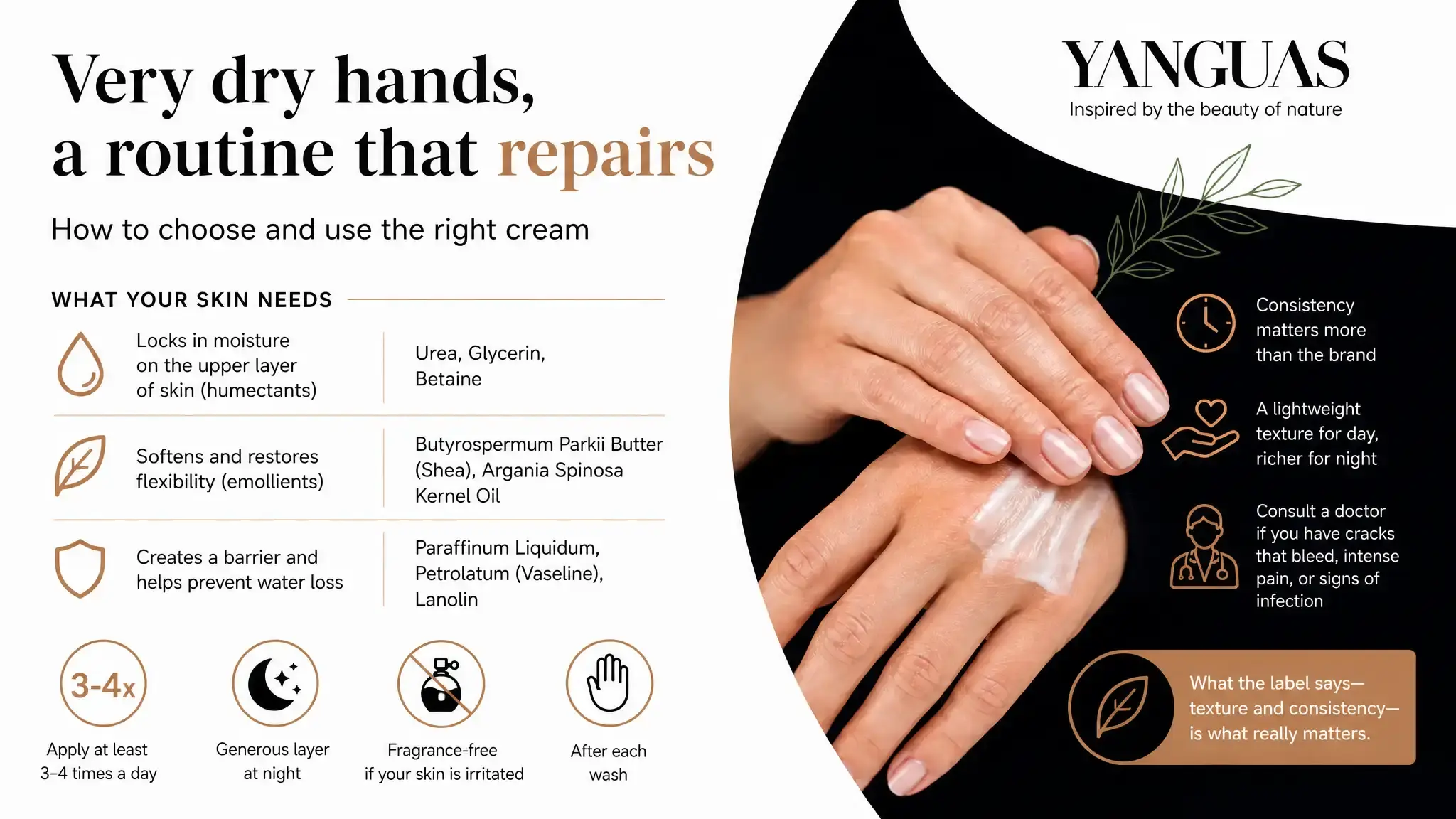
For very dry hands, choose a cream with urea, glycerin or shea butter, fragrance-free if your skin reacts, used after every wash and thickly at night. The brand matters less than three things you can check yourself: what the label says, the texture, and how consistently you use it.
What to Look for on the Label Before You Buy
The ingredient list (the INCI) is printed on the pack, and it is the first thing worth reading. A cream for very dry hands has two jobs: to hold water in the top layer of the skin, and to stop that water from escaping again. The ingredients you are looking for fall into those two roles.
| What it does | How it appears in the INCI |
|---|---|
| Holds water in the top layer of the skin (humectants) | Urea, Glycerin, Betaine |
| Softens and restores flexibility (emollients) | Butyrospermum Parkii Butter (shea), plant oils such as Argania Spinosa Kernel Oil |
| Forms a barrier and slows water loss | Paraffinum Liquidum, Petrolatum (petroleum jelly), Lanolin |
A good cream for dry hands usually combines at least one ingredient from each row. If all you see near the top of the list is water, alcohol and perfume, it is a pleasant cream for normal hands, not a repairing one.
Fragrance is the other line to check. Spain's consumer organisation OCU warns about allergenic fragrances, which are fairly common in these creams and can cause trouble for sensitive skin. On the INCI, perfume is listed as “Parfum” or “Fragrance”: if your hands itch or redden easily, choose a formula without it.
Be wary of “24-hour hydration” promises. According to the same organisation, most creams do not stay on the skin for more than 8 hours, so the cream that really works is the one you reapply, not the one that promises to last all day.
Which Hand Cream Do Dermatologists Recommend?
No serious dermatologist will name a brand without seeing your hands. What medical societies do repeat is the type of product. The Spanish Academy of Dermatology and Venereology (AEDV) says that a suitable emollient based on lanolin, urea and similar ingredients will help keep skin healthy through the winter.
The same academy points out that texture depends on skin type: a fluid suits combination or oily skin, a cream suits dry skin. For very dry hands it pays to go one step further and use two textures. The NHS explains in its guide to emollients that creams are good for daytime because they absorb quickly and are not very greasy, while ointments, thicker and greasier, suit very dry or thickened skin and night-time use.
The practical rule, then, is a light cream for the day's washes and something richer before bed. If your hands still do not improve, a dermatologist can assess your case and prescribe something else. Never start a steroid cream on your own: that decision belongs to a doctor.
How Much Cream to Use and When
How much matters less than when. These are the steps, in order:
- Wash with lukewarm water and a mild, fragrance-free soap. Very hot water and harsh soaps strip the skin's natural oils.
- Pat your hands dry with the towel instead of rubbing, and apply the cream straight away, on freshly dried skin. Every wash without cream afterwards undoes part of the work.
- Use a small amount, enough to cover the backs of both hands with a thin layer. Smooth it gently towards the fingers and between them, and go over the knuckles and cuticles, which are the areas that dry out first.
- Repeat every time you wash your hands. The NHS advises applying emollients at least 3 or 4 times a day, and hands that get wet often will need more.
- Before bed, apply a generous layer of the richest cream you have and let the skin absorb it overnight.
- Protect your hands outside the house. In the cold, wear gloves; for washing up or cleaning with harsh products, wear rubber gloves.
A clue for adjusting the amount: if the cream is still sticky after a minute, you used too much for daytime. If your skin feels tight again half an hour later, you did not use too little; you need to reapply more often or move to a richer texture.
When to See a Doctor or Pharmacist
A hand cream is a cosmetic: it moisturises and protects healthy or dry skin, but it does not treat disease. The Spanish Academy of Dermatology notes that wear-and-tear dermatitis on the backs of the hands is a common reason for consultation in winter, especially among people who wash their hands many times a day for work.
Ask a pharmacist or book an appointment with your doctor if you notice any of these signs:
- Cracks that bleed and do not close within a few days, even with good care.
- Pus, warmth, increasing pain or redness that spreads: these can be signs of infection.
- Intense itching, small blisters or scaly patches, which can be eczema or contact dermatitis.
- Chilblains that break open or ulcerate.
Healing cracks that already bleed and treating chilblains each need their own care, different from the care of dry hands.
How to Tell the Cream Is Working
Look at your hands after washing them, which is when dryness shows. You are on the right track if your skin stops feeling tight, if your knuckles lose that whitish, rough look, and if your hands feel soft in the morning without putting anything on.
There is one sign to stop. If the cream stings or burns and the feeling does not settle after a few days, the NHS describes this as a possible reaction to the product: stop using it and ask for advice. If your skin looks the same after several days of steady use, move up a step in texture or ask at the pharmacy before trying cream after cream.
For the routine to stick, the daytime cream has to sit where you wash and must not keep you waiting for it to dry. Leave a tube by the sink you use most, a light texture such as Nature Beauty Hydrating Hand Cream that you can put on and forget, and keep the richer texture on your bedside table for the night.