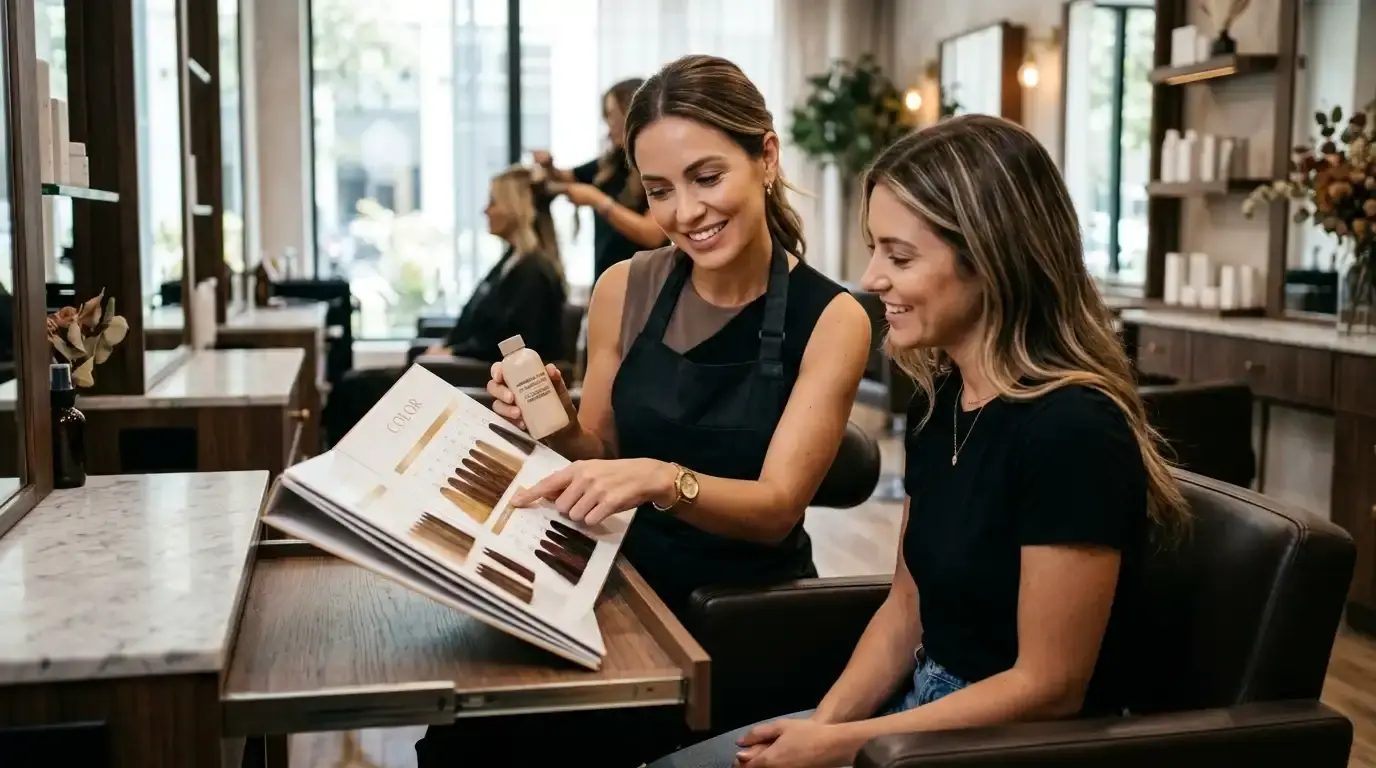

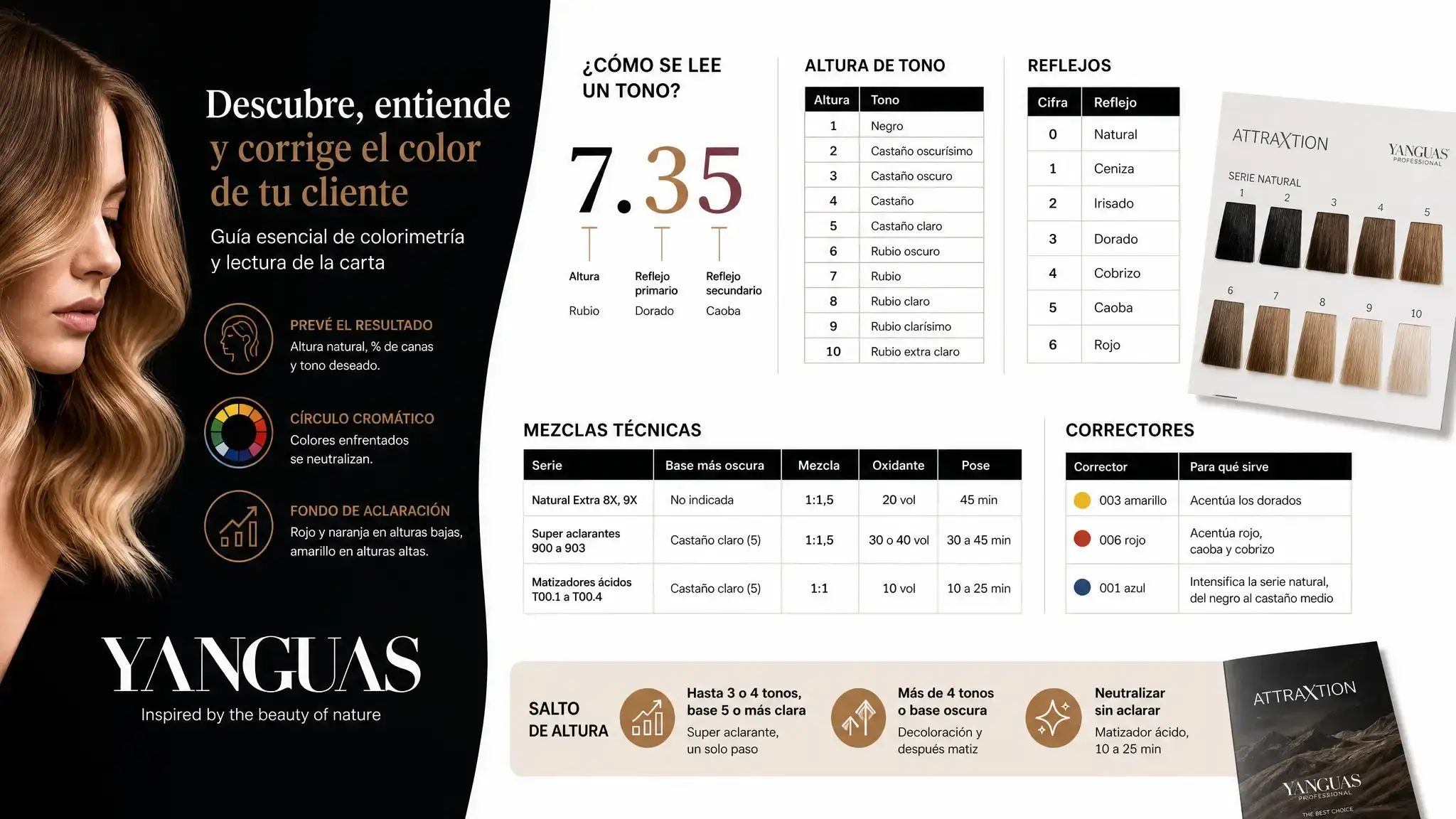
Hair colorimetry is colour theory applied to hair: each shade on a chart is defined by its tone level, from 1 (black) to 10 (extra light blonde), and by one or two reflects, from 0 (natural) to 6 (red). On the Yanguas Professional chart, 7.35 reads as follows: blonde, gold reflect and a secondary mahogany reflect.
What Is Hair Colorimetry?
For the salon, colorimetry is the method that lets you predict the result before mixing. It starts from three facts: the client's natural level, their percentage of grey and the shade they want to reach. With those, you choose the shade on the chart, the developer volume and the processing time.
Its basis is the colour wheel: opposite colours neutralise each other. That is why an orange reflect is corrected with blue, a yellow one with violet and a red one with green.
The second piece is the background that appears as hair is lightened. The more a dark base is lightened, the more warm pigment shows through: red and orange at the low levels, yellow at the high ones. That background is what the corrector or toner has to neutralise, and it is why the same formula does not give the same result on a brown base as on a blonde one.
How to Read the Numbers on a Colour Chart
The Yanguas numbering has two parts. The first number is the tone level, that is, how light or dark the colour is; the numbers that follow, after a point, are the primary reflect and the secondary reflect.
| Level | Shade |
|---|---|
| 1 | Black |
| 2 | Darkest brown |
| 3 | Dark brown |
| 4 | Brown |
| 5 | Light brown |
| 6 | Dark blonde |
| 7 | Blonde |
| 8 | Light blonde |
| 9 | Very light blonde |
| 10 | Extra light blonde |
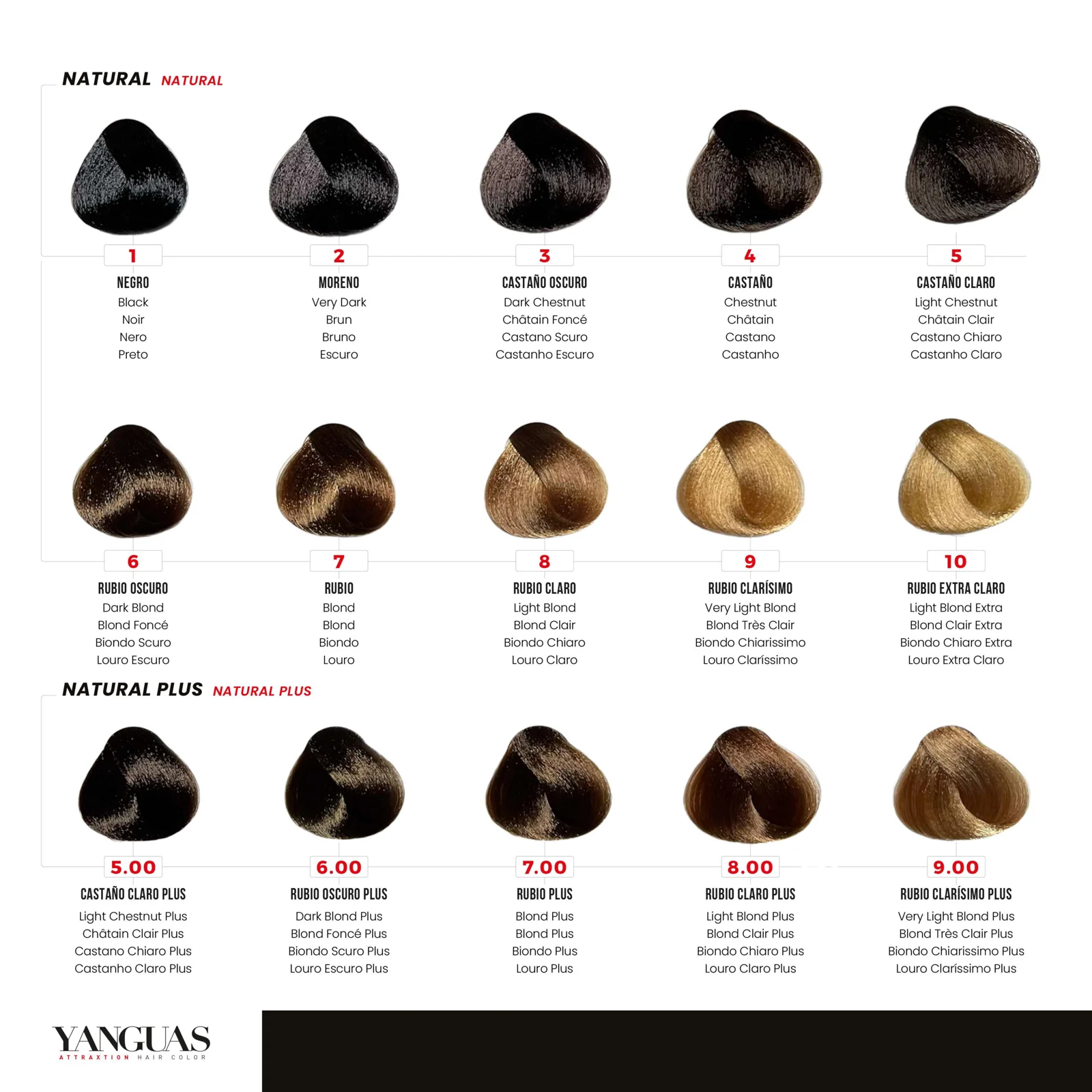
After the point, each digit is a reflect family:
| Digit | Reflect |
|---|---|
| 0 | Natural |
| 1 | Ash |
| 2 | Iridescent |
| 3 | Gold |
| 4 | Copper |
| 5 | Mahogany |
| 6 | Red |
The first reflect dominates and the second one nuances it. In 7.35, gold leads and mahogany adds depth; in a 7.53 it would be the other way round. When a digit is repeated, as in 6.66 intense red dark blonde, the reflect is intensified.
The Series on the Chart and What Each One Is For
The chart for Attraxtion, the Yanguas permanent cream colour, groups its shades into series. The base ones are Natural (1 to 10), Natural Plus (5.00 to 9.00) and Natural Extra (8X and 9X). Then come the reflect series: iridescent, ash, beige, gold, browns, pearl, reds, mahogany, violet, copper and tobacco, plus platinums, intense colours and pastels.
The general mix is 1:1, 100 ml of cream with 100 ml of developer. The technical series change that rule, and they are worth keeping at hand at the chair:
| Series | Darkest base | Mix | Developer | Time |
|---|---|---|---|---|
| Natural Extra 8X, 9X | Not stated | 1:1.5 | 20 vol | 45 min |
| Super lighteners 900 to 903 | Light brown (5) | 1:1.5 | 30 or 40 vol | 30 to 45 min |
| Acid toners T00.1 to T00.4 | Light brown (5) | 1:1 | 10 vol | 10 to 25 min |
Super lighteners lift 3 to 4 levels on a natural base no darker than light brown. The 000 lightening booster is mixed in equal parts with them, or with any base colour, to gain up to one more level of lift. Which colour system suits each service is covered in which professional hair colour salons use.
How Do You Correct a Colour with the Chart?
With the correctors, which on the Attraxtion chart work as colour boosters and are dosed according to the intensity you want:
| Corrector | What it does |
|---|---|
| 003 yellow | Enhances golds |
| 006 red | Enhances red, mahogany and copper |
| 001 blue | Intensifies the natural series, black to mid brown |
Blue is also the counter-colour of orange and red reflects, which is the colour wheel applied in a tube. When the unwanted tone sits on a light base, the tool is the acid toners, which neutralise it without lifting.
For highlights and fashion effects, the chart includes Contrast, which intensifies any shade by adding a quarter, a third or half a tube, never going beyond half and half. It is mixed 1:1.5 with 20, 30 or 40 volume developer depending on the tone and lift.
💡 Technical tip: before choosing a corrector, look at the background showing at the roots and mid-lengths. If it is orange on a dark base, use the 001 blue; if it is an unwanted yellow on a light base, use a T00 acid toner.
How Much Should a Salon Charge for Bleaching?
There is no reference rate: each salon sets its own. What colorimetry provides is the fact that justifies it, the level jump between the natural base and the target shade, because it decides the product, the developer and the time at the chair.
| Level jump | Usual technique |
|---|---|
| Up to 3 or 4 levels, base 5 or lighter | Super lightener, one step |
| More than 4 levels or a dark base | Bleach, then tone |
| Neutralise without lifting | Acid toner, 10 to 25 min |
A service that needs bleach and toner is two technical steps, two products and more time, and the price should reflect it. Yanguas makes bleaches with Plex technology that lift up to 9 levels, designed for that second case.
The full Attraxtion chart is available as a PDF with every series and its mixing instructions, and the Free and Hidracolor charts are in the Yanguas professional colour section.