
Five Areas of the Salon Where Products Sell Themselves
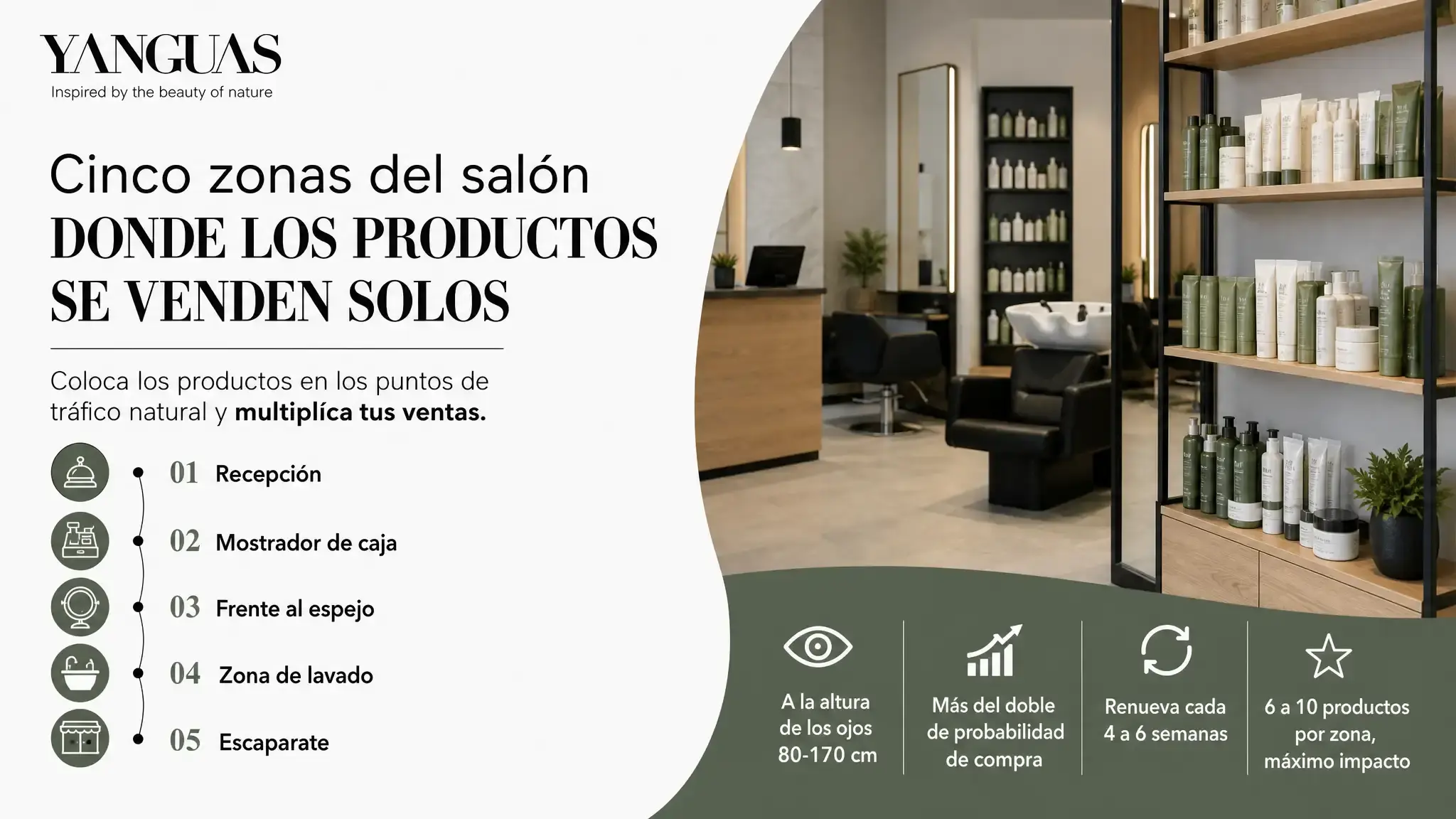
Retail products in a hair salon generate more sales when they are placed in five natural traffic points: the reception, the checkout counter, in front of the mirror, the backwash area, and the window display. The golden rule is to position the product at eye level (between 80 and 170 cm from the floor), where the probability of purchase is more than double that of lower shelves.
The Five Zones with the Greatest Visual Impact
The layout of the salon creates predictable paths. Taking advantage of them turns the space into a silent salesperson.
Reception and entrance counter. This is the client's first and last contact with the salon. Placing small-format products, home maintenance treatments, or seasonal novelties here ensures the client sees them twice: upon arrival and when paying. A compact display organized by product family conveys professionalism and facilitates the purchase decision during those few seconds of waiting.
Checkout counter. This is the most impulsive purchase zone in any retail point of sale. Items located between waist and eye height, right in front of the register, account for the highest percentage of unplanned purchases. Single-dose masks, small-format repair oils, or weekly styling products fit perfectly here.
In front of the mirror, at the seated client's level. During the service, the client looks at the mirror for dozens of minutes. A small display to the side of the chair or a shelf integrated into the workstation turns that passive waiting time into active product exposure. The professional can point out what they are using at that moment, generating a direct recommendation with the item visible.
Backwash area. The client is relaxed and receptive. A small selection of hair treatments at counter height, with visible labels, allows the professional to present the product they have just applied and suggest purchasing it to continue care at home.
Window display. This works outward, capturing the curiosity of those who are not yet clients, and inward, reinforcing the salon's brand image. A composition renewed every season, with two or three featured products well-lit, communicates that the salon is also a retail point and not just a service provider.
At What Height Should You Place Products on the Display?
The level of exposure determines the probability of sale more strongly than any other merchandising factor. According to the principles of the professional retail shelf, the distribution by levels works like this:
| Level | Approximate height | Probability of sale |
|---|---|---|
| Eye level | 80-170 cm | 52% |
| Hand level | 50-80 cm | 26% |
| Floor level | 0-50 cm | 13% |
| Head level | over 170 cm | 9% |
Products with the highest margins and new additions should always go at eye level. Higher rotation or larger volume products (large maintenance containers) can occupy the hand level. The floor and head levels are reserved for backup stock, never for active display.
💡 Pro tip: rotate the position of products every four to six weeks. A regular client who visits the salon monthly will perceive the change as something new and pay attention to products that previously went unnoticed.
Cold Zones and How to Activate Them
Not all areas of the salon receive the same traffic. Cold zones are those away from the client's natural path: side corners, secondary corridors, or shelves located behind the work area.
According to the fundamentals of merchandising in points of sale for SMEs, cold zones are activated by placing frequently consumed products that the client needs to look for. This forces the path, and during that journey, the client passes other products they didn't have in mind. The technique shifts part of the natural traffic toward areas that would otherwise remain invisible.
In a hair salon, a typical cold zone is the back side wall. Placing commonly used shampoos and conditioners there, and reserving the reception for treatments and novelties, creates that guided path without the need for additional signage.
The Role of the Branded Display
A branded display with its own visual identity does two things a generic shelf cannot: it groups the range coherently and communicates that these products are professional, not from a supermarket. The visual difference matters because salon clients buy partly out of trust in the professional and partly because of the environment in which that professional works.
A well-designed display, with the complete range organized and labeled, also facilitates the professional's task: they can point to the product by name, explain the family it belongs to, and recommend the complement without having to search through various loose items. The sale becomes a natural extension of the service, not an interruption of it.
How Many Products Make for an Effective Display?
The common tendency is to display too many products at once, which produces the opposite effect: the client doesn't know where to look and buys none. A selection of between six and ten references per display area, ordered by family or need (hydration, repair, hold, color), is more effective than a saturated shelf.
As noted by Beauty Market, placing products in the window, at reception, on the mirror station, and next to the backwash units multiplies the touchpoints without needing to invest in external advertising. The key lies in visual consistency and cleanliness: a dusty display or disorganized products sends the opposite message to what the salon wants to project.
Renewing the selection every season, aligning it with the treatments the salon is promoting during that period, and ensuring that each display area has a featured product visible from a distance are the three habits that separate a salon with constant retail sales from one that only sells when the client asks.