
Professional Styling Builds the Loyalty that Color Promises
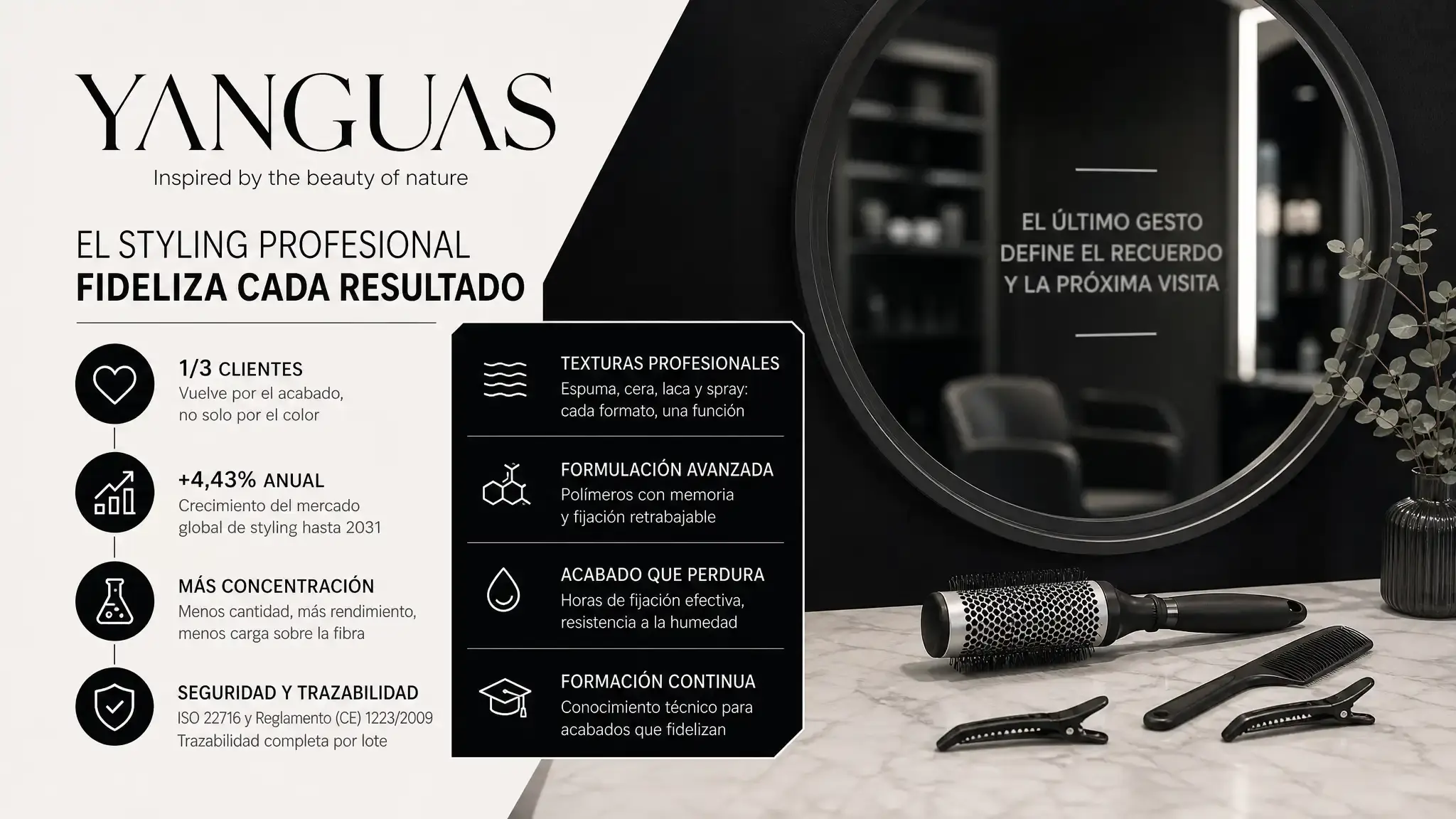
The finish is the moment the client decides whether to return: it is the last thing they see in the mirror, what they touch at home, and what they show off the next day. Professional styling, correctly formulated and applied with technical judgment, transforms that moment into the salon's most profitable business lever, both in terms of ticket size and loyalty.
Why Does the Finish Determine the Perception of the Entire Service?
Technical services, such as color or bleaching, are evaluated rationally: the client understands they have invested time and money in a chemical result. The finish, on the other hand, is perceived emotionally. It is what they touch, look at, and wear when they step out onto the street.
If the hairstyle doesn't hold or the fixative leaves a white residue when brushed, the perception of the entire service deteriorates, even if the coloring was flawless. The failure of the final touch contaminates the memory of everything that came before.
This dynamic carries market weight. According to Mordor Intelligence, the global hair styling products category will reach 12.47 billion dollars by 2031, growing at an annual rate of 4.43%, with styling waxes and creams exceeding that average. The end client no longer seeks only hold: they demand natural texture, reworkable results, and a finish that respects the hair fiber.
How Professional and Retail Formulations Differ
The gap between professional styling and supermarket products isn't in the packaging or the price: it's in the formulation. Mass-market products are designed to work acceptably on any hair type and in any hands, which requires simplifying the formula, reducing the concentration of active ingredients, and prioritizing industrial cost over technical performance.
Professional styling operates with the opposite logic. The concentration of fixing polymers, the balance between water and alcohol, the type of copolymer chosen, and the combination with conditioning agents are calculated so the stylist can control the result with precision.
The industry is moving toward shape-memory polymers, capable of allowing the hairstyle to be reworked without losing structure, and toward film-forming agents that combine hold with conditioning in a single step. This technology is incorporated into the professional lines of direct manufacturers before reaching retail, precisely because its formulation complexity requires total control of the process.
💡 Technical purchasing criteria: demand technical data sheets from your supplier with documented effective hold hours and humidity resistance. A label that says "strong hold" without supporting data is not a technical argument.
How Different Textures and Formats Enhance Performance
Professional textures are designed to respond to the stylist's touch, not to be tolerated by any user. Each format has a specific function within the service:
| Texture | Professional Function |
|---|---|
| Mousse | Uniform distribution, controlled volume without weighing hair down |
| Wax | Strand-by-strand work, definition without greasy residue |
| Hairspray | Fine, dry spray, hold without a stiff effect |
| Texturizing spray | Natural finish with movement, suitable for reworking |
The concentration of active ingredients in a professional line is significantly higher than that of a retail equivalent. This translates into direct performance: the stylist needs less product for the same effect, which reduces the cost per service and minimizes the load on the hair fiber.
Performance is measured by specific parameters: effective hold hours, humidity resistance, absence of flaking, and ease of removal. Professional manufacturers document these parameters; supermarket products rarely do.
What Should a Salon Demand from Its Styling Supplier?
A professional salon should evaluate its styling supplier using the same criteria it applies to its coloring supplier. The first filter is traceability and certification: compliance with the ISO 22716 standard for Cosmetic Good Manufacturing Practices and conformity with Regulation (EC) 1223/2009, the European legal framework regulating the safety of all cosmetic products marketed in the European Union.
Beyond certification, these are the criteria that distinguish a core supplier from one of convenience:
| Criterion | What It Guarantees |
|---|---|
| ISO 22716 and compliance with Regulation (EC) 1223/2009 | Product safety and batch traceability |
| In-house manufacturing | The product the brand signs is the one it produces |
| Professional channel protection | No presence in marketplaces or big-box retailers |
| Continuous technical training | The stylist knows how to combine products and build finishes |
| Range consistency | All textures follow the same formulation logic |
In-house manufacturing completes the argument: when the manufacturer that signs the product is the same one that produces it in its facilities, quality control does not depend on third parties and the traceability of each batch is complete.
Using the Backbar as a Business Tool
A salon's backbar is not a storage area: it is the physical translation of the business's technical philosophy. When built with consistency—one manufacturer and a complete technical line with its own narrative—it becomes a loyalty tool as powerful as the coloring service itself.
Every client who finishes a service represents an additional ticket opportunity: a hairspray, a wax, or a texturizing spray doesn't just generate margin at that moment. They are the extension of the salon result into the home, the way to maintain the hairstyle between visits, and the mechanism that turns a good one-time finish into a loyalty-building routine.
Working with a direct manufacturer provides three elements that a multi-brand distributor cannot offer with the same consistency: consistency between textures under the same formulation philosophy, technical training on how to combine products to build signature finishes, and protection of positioning because the brand does not compete with itself in price-driven channels. This combination is what turns the backbar into a system, rather than a shelf without criteria.