
Moving from Green Marketing to Real Sustainability in the Hair Salon
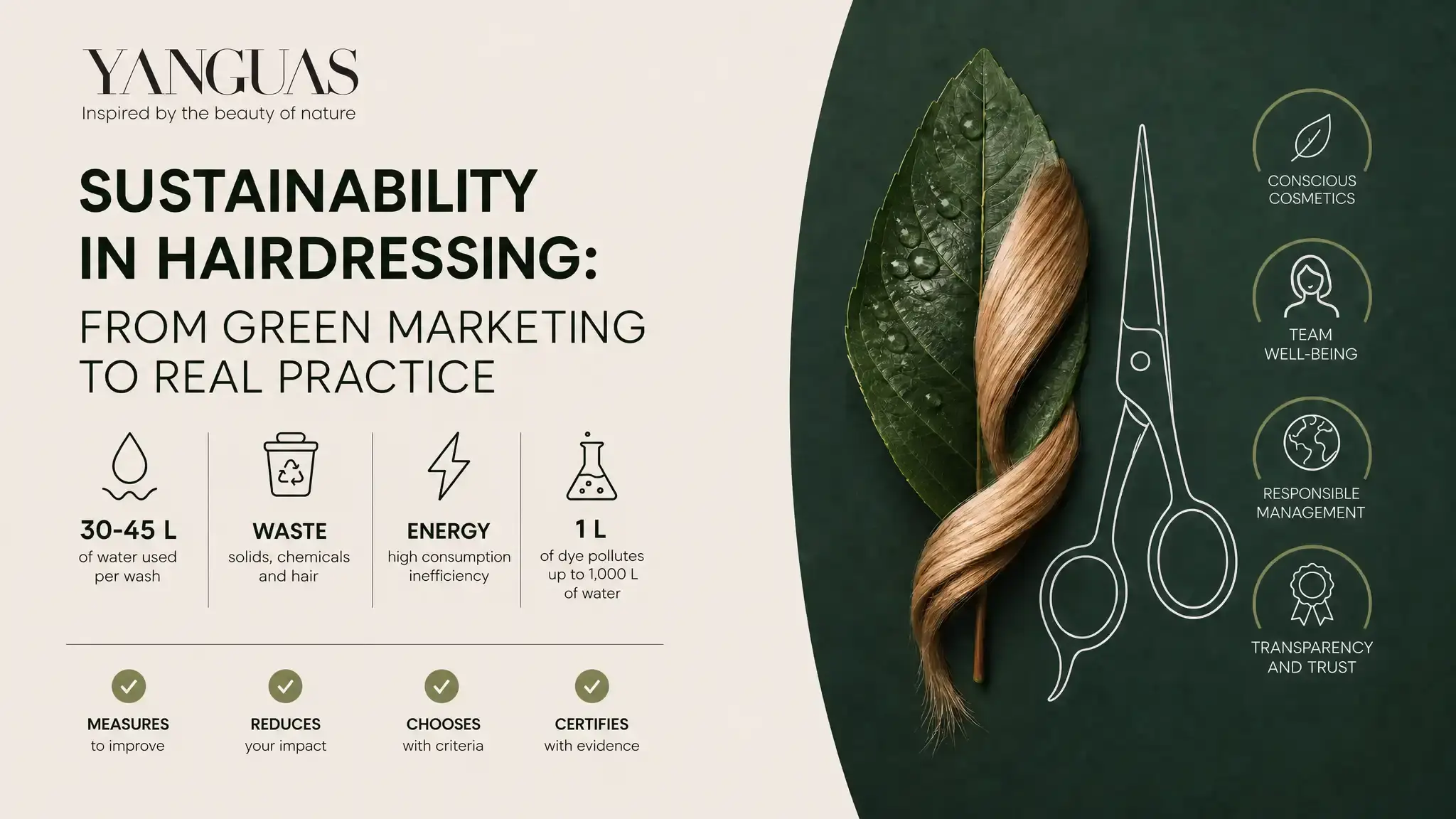
A sustainable salon isn't one that just puts up a recycling sign at reception: it's one that measures its water, energy, and waste consumption and can prove it with certifications or concrete data. The difference between green marketing and real practice is measured in verifiable evidence, not slogans.
What Does Being a Sustainable Hair Salon Really Mean?
Sustainability in a beauty salon involves a structural commitment to the business's environmental, social, and economic impact, which is measurable and verifiable in every process. It isn't just about offering "natural" dyes of unknown origin or labeling the business as "eco" without any backing.
A sustainable hair salon works on specific pillars: biodegradable products with declared compositions, efficient appliances, real water-saving measures, and certified waste management, including materials like aluminum, color tubes, and the cut hair itself. None of these pillars work in isolation.
The concept of bio-hairdressing adds an extra layer: a philosophy of holistic well-being, where ventilation, furniture materials, and indoor air quality are part of the commitment to the health of both the client and the team.
How Conventional Salons Impact the Environment
Before discussing solutions, it is worth measuring the problem. A medium-sized salon generates an impact that most owners are unaware of in detail.
| Area | Estimated impact |
|---|---|
| Water | 30-45 liters per wash, many contaminated with dye residue |
| Solid waste | Gloves, capes, packaging, aluminum, and cut hair |
| Energy | Hairdryers, flat irons, and climate control without efficiency measures |
| Chemicals | 1 liter of poorly disposed dye can contaminate up to 1.000 liters of groundwater |
Oxidation dyes, bleaches, and texture-changing products contain compounds that, without proper management, contaminate the soil and waterways when discharged without prior treatment. The volume of solid waste in the sector is equally significant: Spanish hair salons generate billions of kilos of hair per year, most of which goes to landfills instead of being reused.
💡 Professional tip: always start with an internal audit. Without measuring weekly water consumption, monthly waste, and the source of energy, any subsequent improvement is difficult to communicate with real figures.
Understanding the Conscious Consumer
The client looking for a sustainable salon is not a marginal niche. According to the British Beauty Council, 41% of consumers feel guilty about the environmental impact of their beauty and personal care products and are willing to change their purchasing habits accordingly.
In Spain, this consumer fits a specific profile: they are between 28 and 50 years old, predominantly female, check ingredients before using them, and value transparency regarding manufacturing processes. They are willing to pay more if the value proposition is clear and credible.
What they do not forgive is inconsistency. A salon that talks about sustainability but displays products in single-use plastic packaging, or that has no certification to back up its claims, loses credibility immediately.
Transitioning from a Conventional Salon to a Bio-Salon
The transition does not have to be radical or immediate. The most common mistake is transforming the salon overnight, assuming unsustainable costs and losing regular clients due to a change in the offering that hasn't been communicated.
A progressive approach is structured into four phases:
1. Internal audit. Measure how much water the salon consumes per week, how much waste it generates per month, and what percentage of energy comes from renewable sources. Without data, there is no plan.
2. Reducing operational waste. Replace disposable gloves with reusable ones, eliminate single-use plastic at reception, implement waste separation, and contact authorized managers for chemical waste. Low-cost measures with real impact: low-flow showerheads installed in backwash units can reduce water consumption by 40% to 65% without affecting the service.
3. Reviewing the product catalog. Prioritize manufacturers that offer verifiable documentation on their processes: declared composition, manufacturing certifications, and packaging policy. It is not enough for the supplier to claim they are sustainable.
4. Progressive certification. Programs such as Green Salon Collective or the European Ecocert offer accessible certification frameworks for independent salons. Working with manufacturers that certify their processes through the ISO 22716 Good Manufacturing Practices for Cosmetics standard is a decision the salon can communicate with concrete arguments and that the client can verify.
Why Conscious Cosmetics and Team Health Matter for Ethical Positioning
Conscious cosmetics is not a type of product: it is a selection criterion. A product is conscious when its entire life cycle—from formulation and manufacturing to packaging and logistics—has been designed with a reduced impact in mind. Integrating it into the catalog involves demanding full technical data sheets and certifications before adding any reference, and training the team to understand the ingredients they apply.
Sustainability also reaches the people working inside the salon. Continuous exposure to compounds such as ammonia, persulfates, and formaldehydes represents a real risk to the team's health: studies published in the US National Library of Medicine have linked chronic exposure to these compounds with endocrine disruption and a higher incidence of respiratory diseases in hairdressing professionals. The team's working conditions are part of the sustainable model, not a secondary variable.
Greenwashing erodes consumer trust to worrying levels. An ethical salon operates under a simple principle: only communicate what can be proven. This implies transparency in the origin of products, in the team's working conditions, in waste management, and in the space's energy footprint. Salons with verifiable sustainable positioning tend to have a higher average ticket price because a client willing to pay more for a conscious service is also usually more loyal and actively recommends the business.