
Exclusive Channels Protect Salon Margins While Mass Markets Erode Them
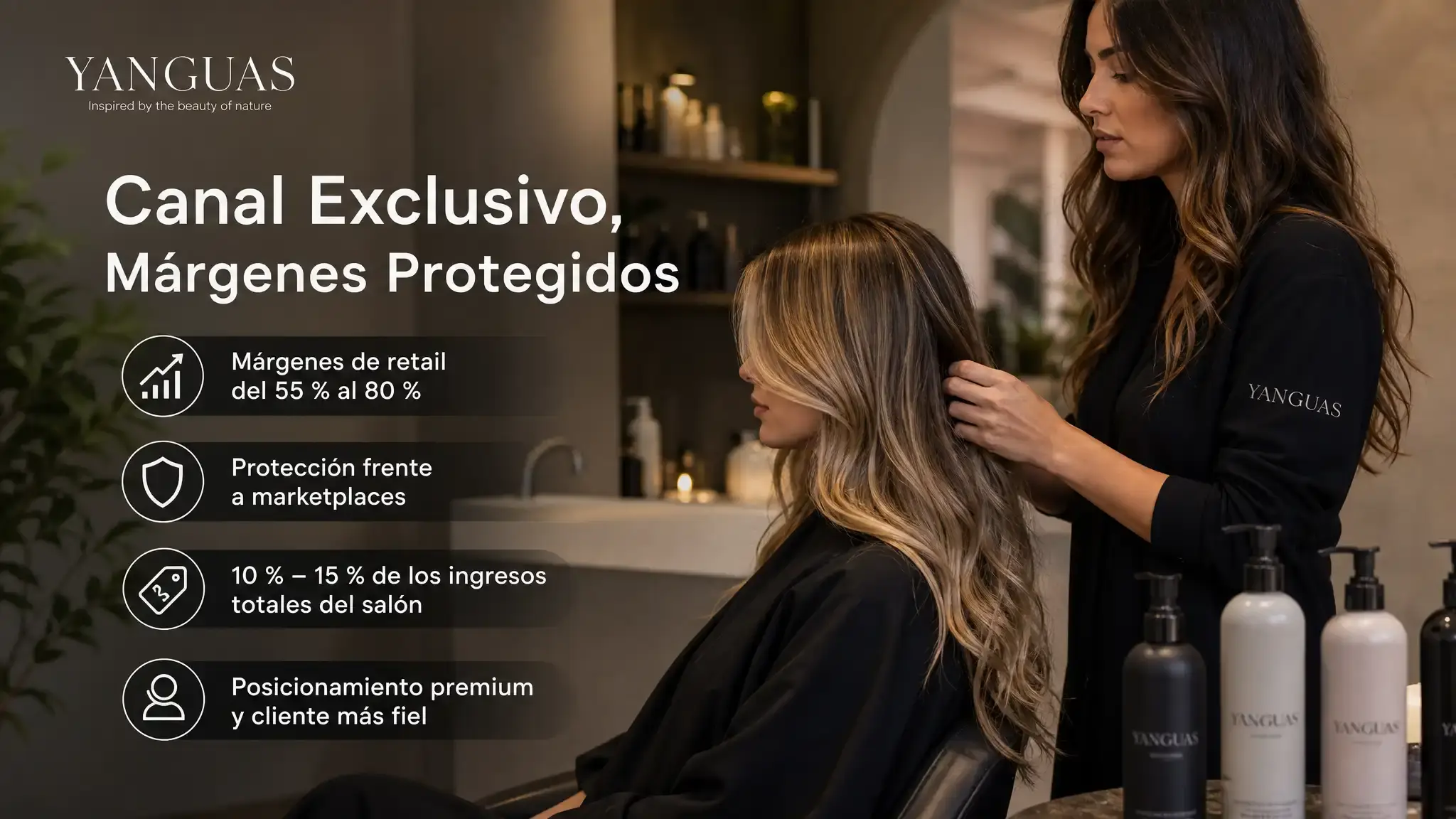
An exclusive channel brand is one that does not appear on marketplaces, big-box stores, or mass e-commerce: it only reaches the final customer through the professional salon. This restriction is not a commercial whim; it is the reason why product sales in the salon can generate margins between 55% and 80%, compared to the 8% typical net margin of services.
What Happens When a Professional Brand Is Sold on Amazon?
When a customer finds the same product their salon uses in services on Amazon, at cost price or below, what the industry calls channel conflict occurs. The effect is twofold: first, they stop perceiving value in buying it at the salon; second, they start questioning whether it is worth paying the service price if they can replicate it at home.
According to i2o Retail, brands that do not control unauthorized resale lose control over their pricing strategy and their brand position across all digital channels. For the salon, the practical consequence is the erosion of the average ticket and the drop in retail sales, which is precisely the most profitable line.
The Real Profitability of In-Salon Products
The numbers explain why retail sales matter more than they appear on the bottom line. According to BusinessDojo, product sales in the salon represent between 10% and 15% of total revenue, but contribute gross margins of between 55% and 80%, well above services. The average net margin of a well-managed salon is around 8%, according to Salon Industry Statistics from Boulevard; without product sales, that number shrinks.
The problem is that these margins depend on one condition: the product cannot compete with itself in the online channel. As soon as it appears on a marketplace at a lower price than the salon's, comparison is inevitable and the sales pitch falls apart.
💡 Check before you commit: search for every brand you work with directly on Amazon and Google Shopping. If it appears, your retail margin is already exposed to a price war you cannot win from the salon.
The Market Is Growing but Not Equally for Everyone
The global professional hair care product market will reach 38,300 million dollars by 2036, with an annual growth of 4.6%, according to Fact.MR. The direct-to-salon (B2B) channel will account for 40% of distribution in that timeframe.
This growth is not distributed uniformly. Salons that control their value proposition, work with brands that protect their channel, and build a narrative of exclusivity capture a disproportionate share of the increase. Those that depend on brands present in marketplaces, however, compete against a rival with a larger marketing budget and lower prices: the mass market itself.
How to Evaluate if a Supplier Truly Protects Their Channel
Not all brands that present themselves as exclusive to professionals are so in practice. Some manufacture the same product under different names for the consumer channel, or allow their distributors to sell online without restrictions. Before committing, it is advisable to verify these criteria:
| Criterion | What to check |
|---|---|
| Documented channel policy | Does it exist in writing and is it actively communicated? |
| Online sales control | Does it monitor violations and act upon them? |
| Presence on marketplaces | Does it appear under any name, format, or reseller? |
| Professional support | Does it offer technical training, not just products? |
Exclusive distribution implies a two-way commitment: the brand protects the salon and the distributor, and they build the brand's value in their territory. A supplier that does not actively monitor its channel transfers the risk it should assume to the salon.
Premium Positioning Depends on Product Exclusivity
A salon's perception of value is linked, in part, to the products it uses and sells. When a customer sees the same product their salon recommends discounted on Amazon, something breaks in the narrative: the trust that they are receiving something they cannot get elsewhere.
Conversely, when a professional can honestly state that the product is only available in specialized salons, the effect is the opposite. An accessible luxury argument is built that justifies the price of the service and the product, which no marketplace can replicate because exclusivity is, by definition, what marketplaces destroy.
Transitioning to Exclusive Channel Brands
Changing suppliers is not just a purchasing decision. The first step is to audit current brands: which ones are available on Amazon or other mass channels and what real impact they have on retail sales and customer perception.
The second is to research manufacturers that verifiably control their distribution, with their own production, quality certifications, and a documented channel protection policy. The third is to train the team: a brand change does not work if professionals do not know the products thoroughly or know how to argue their value to the customer.
The fourth step is to communicate the transition to the customer as an improvement, not a loss. With the right approach, moving to exclusive brands reinforces the salon's positioning in the premium segment and turns product exclusivity into an asset of the experience, rather than a restriction on access.